Ask a room of strangers what would go wrong in a world where nobody had to work to survive, and you will get the same answer in about four seconds. Nobody would do anything. It is the first objection, it is the strongest one, and it deserves better than a slogan.
The objection, at full strength
Let's not soften it. Most people do not love their jobs. They go because the alternative is losing the apartment, the car, the coverage, the standing. Work, for an enormous number of people, is something survival extracts from them rather than something they chose. Remove the consequence and you have removed the reason.
And there is a second half that people rarely say out loud but almost always feel: I would still contribute. It's everyone else I'm worried about. That part is worth sitting with, because it is the tell. Almost nobody raising this objection is describing themselves. They are describing a neighbor they have imagined.
What we can actually observe
We can't run the experiment. But we can look at every place where survival is already decoupled from earning, and watch what people do with the freedom.
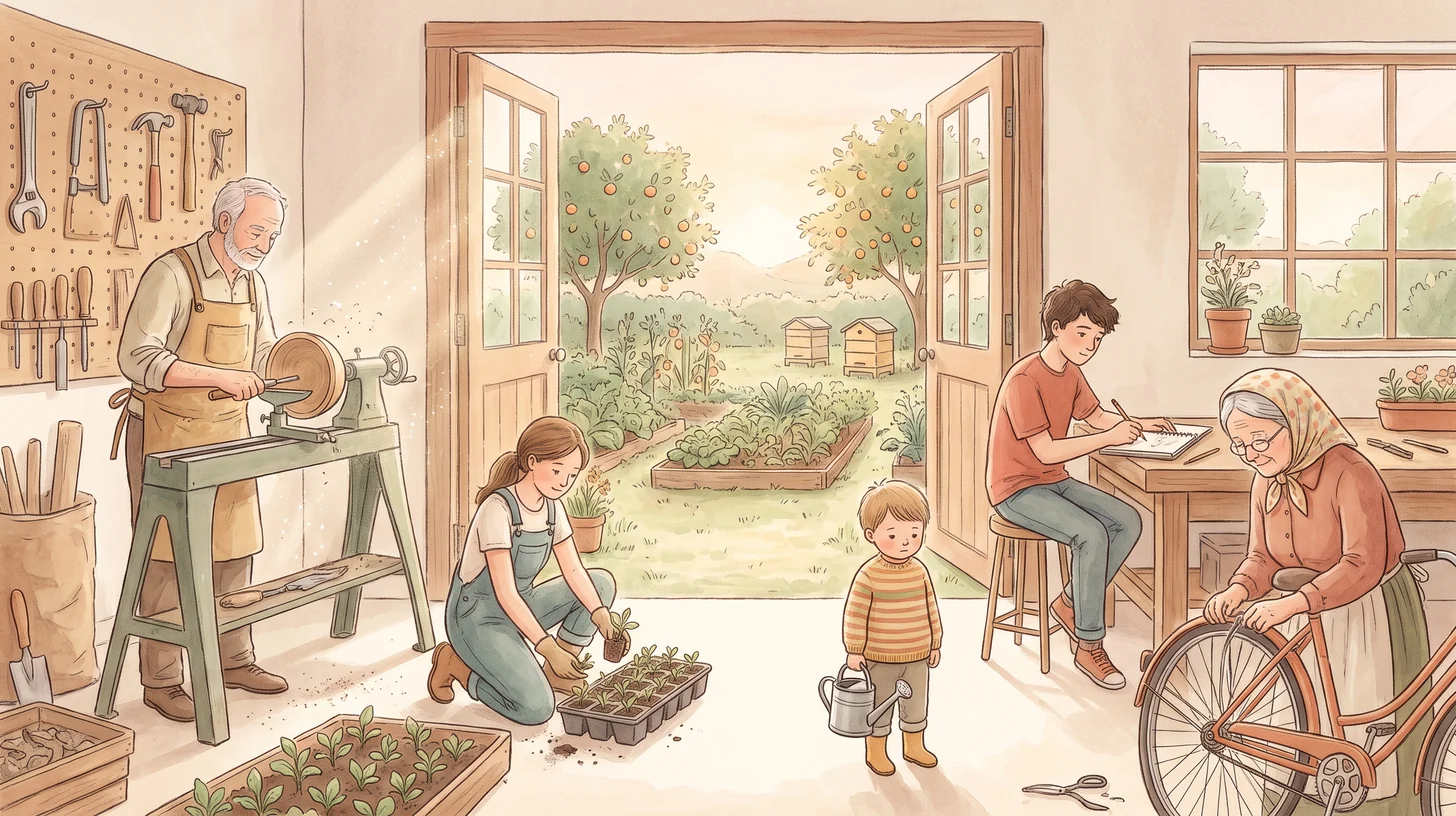
Retired people are the largest such group on Earth. Released from any obligation to earn, they overwhelmingly do not stop. They garden, mind grandchildren, volunteer, restore things, sit on committees, teach, organize, feed people. The retirement everyone fears — an armchair and a television — turns out to be a minority outcome, and one that tends to travel with poor health rather than with free time.
Then there is the enormous amount of work that is already unpaid. The International Labour Organization estimates that people perform roughly 16.4 billion hours of unpaid care work every single day, and that valuing it at minimum wage would put it somewhere near 9% of global GDP. Raising children. Tending the sick and the old. Cooking, cleaning, keeping households and neighborhoods upright. It is arguably the largest block of productive labor on the planet, and not one hour of it is done for a wage.
Add the parts of modern life that were simply given away. The encyclopedia most of the world reaches for first was written by volunteers. So was a great deal of the software the internet runs on. People with no contract and no paycheck built infrastructure that billions now depend on daily, and then left it lying around for anyone to use.
The question was never whether people will work without a whip. Billions of them already do.
"Lazy" is doing two jobs in one word
When people say lazy they usually mean one of two quite different things. The first is idle: doing not much. The second is useless: doing nothing that helps anyone. Copiosis treats those differently, on purpose.
It is genuinely indifferent to the first. If your necessities are covered and you spend a year reading, walking, and being unremarkable, the system has no lever to pull on you and doesn't want one. No work requirement, no means test, no caseworker, no points for looking busy.
It pays close attention to the second, but never with punishment. NBR is generated when what you do produces net benefit for other people. Nothing bad happens if you produce none. Something good happens if you do. That is the entire mechanism: the floor is unconditional, and everything above the floor follows benefit.
What the objection gets right
Some people will contribute nothing. That's true, and pretending otherwise would be dishonest.
It is also true right now. Every society already carries people who produce nothing anyone else values, and it carries them at both ends of the wealth distribution. The difference is that today we tell ourselves the threat of destitution is what prevents this, while quietly observing that destitution mostly produces desperate people rather than productive ones.
So the honest position isn't that everybody will contribute. It's that a society able to cover everyone's necessities doesn't need to threaten the many in order to motivate the few — and that the real cost of carrying someone who does nothing is small, falling every year, and almost certainly cheaper than the machinery we currently run to make sure they suffer for it.
A version of this you have already lived
Think about the last thing you did well that nobody paid you for. A meal cooked properly for people you love. Something you fixed. A friend talked through a bad night. An instrument practiced badly for a year. Something you built, wrote, planted, or organized because it bothered you that it didn't exist.
Now ask honestly whether that was worse work than what you do for money, or better. For most people the answer is a little uncomfortable, because it's better — more careful, more attentive, more theirs. That isn't proof that money ruins everything. It's just an observation that the theory underneath the objection, that humans act only under financial threat, doesn't describe the human being raising it.
What we're not telling you
This is a design claim, not a result. No community is running Copiosis and there is no pilot to point at, so nothing above is evidence in the strong sense.
The observations have real limits. Retirees, volunteers and open-source contributors all live inside a money economy, with savings, pensions, or a salaried day job standing behind them. Unconditional income experiments are the closest genuine evidence available, and they are small, time-limited, and argued over by serious people on both sides. None of them removed money from the picture, which is the thing Copiosis actually proposes.
And we don't know the equilibrium. What fraction of people would contribute, whether that fraction holds across a generation raised without the whip, whether enough people would take on the unglamorous work — these are open questions, and anyone answering them with confidence is selling something.
What we will claim is narrower, and we think it holds. The objection rests on a premise: that fear of destitution is the only reliable reason humans act. That premise isn't supported by retirement, by care work, by volunteering, by the open commons, or by your own last good weekend. It remains the strongest objection Copiosis faces. It is also, on inspection, the one carrying the least evidence.