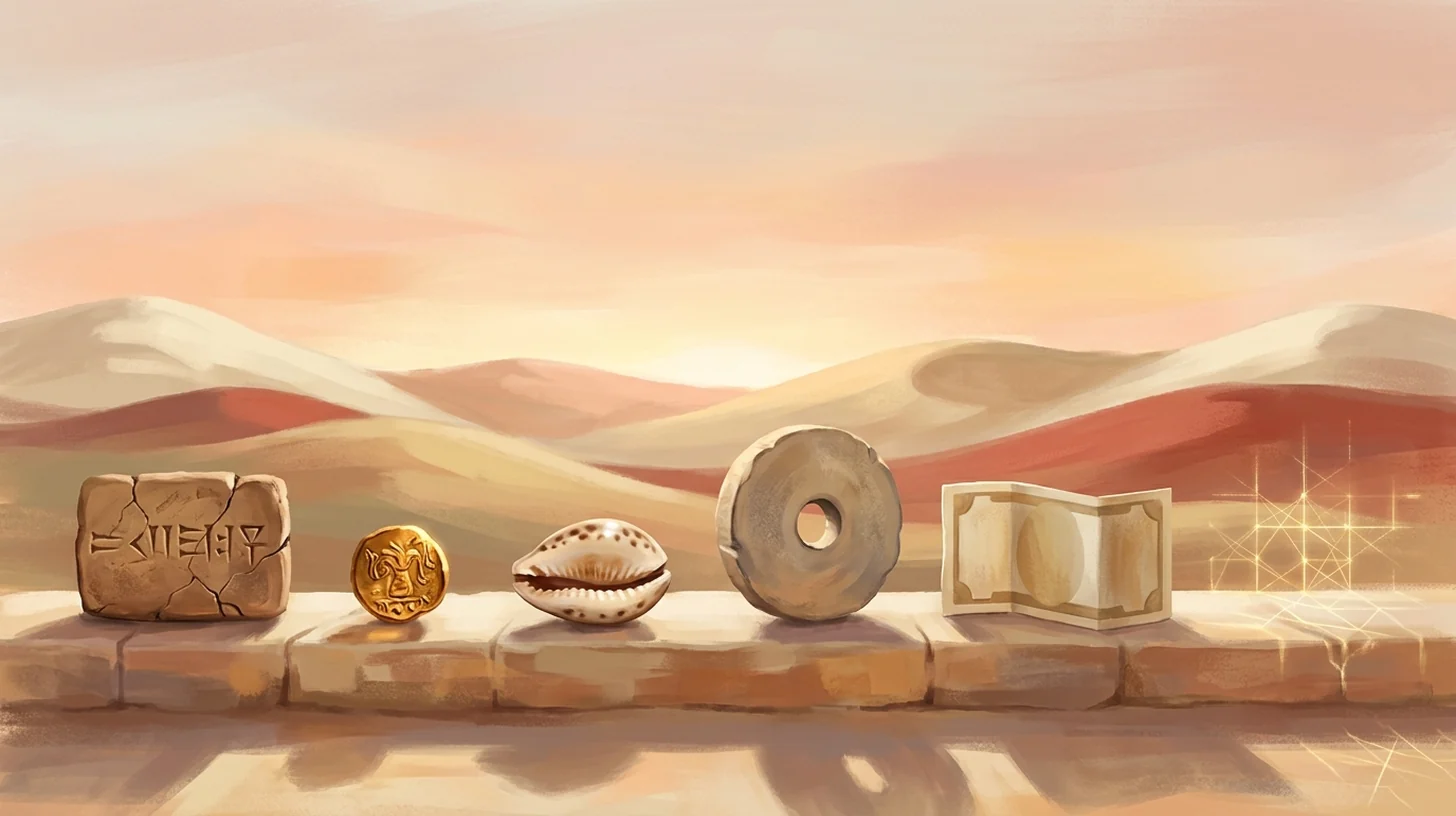
Tell someone that money might stop being how we organize an economy, and the answer comes back almost word for word every time: money has been around forever. It's human nature. You can't just get rid of it. The first part of that is true, and it deserves to be taken seriously. The second part doesn't follow — because the thing we call money has been torn up and rebuilt from the ground up at least five times, and on every single occasion the people living through it were certain that the version they had was money itself.
This is a story worth knowing on its own merits. It's also the most useful thing you can read before arguing about the future of money with anyone, in either direction.
It started as bookkeeping
Most of us learned a tidy origin story in school. Once upon a time people bartered. Barter was clumsy — you had a chicken, I had shoes, and we had to want each other's goods at the same moment. So somebody invented money to fix it. Adam Smith told a version of this in 1776, and it has been repeated ever since because it is simple, intuitive, and explains money as a clever solution to an obvious problem.
The trouble is that anthropologists went looking for the barter stage and couldn't find it. In a 1985 paper that has been quoted ever since, the Cambridge anthropologist Caroline Humphrey put it bluntly: no example of a barter economy, pure and simple, has ever been described, let alone the emergence from it of money, and all available ethnography suggests there never has been such a thing. In the best-documented cases, widespread barter shows up after money — among people accustomed to currency who suddenly had to manage without it.
This is a genuinely contested area, and it's worth being straight about that. The objection to Smith's story is old — Alfred Mitchell-Innes was making it in 1913 — but the strong version popularized by the late anthropologist David Graeber has been pushed back on hard by economists, who point out that the early theorists never denied credit existed, and that a gap in the ethnographic record isn't quite proof of absence in the deep past. Fair enough. But the archaeological record is not really in dispute, and it points the same direction.
What it shows, in Mesopotamia from around 3000 BCE, is accounting. Temple and palace scribes tracked grain and livestock in and out on clay tablets, and valued everything — a basket of barley, a day of hired labor, a bolt of wool — against standard units. One of those units was the shekel, which began life not as a coin but as a weight, used in parallel for a quantity of barley and a quantity of silver, with an official rate between them. These were institutional accounts rather than anything like a bank, but the principle is unmistakable: value was being recorded and reconciled long before it was ever minted.
The oldest money we can actually document is not an object. It's a record of who owes what to whom.
Hold onto that, because it comes back at the end.
Reinvention one: the coin
Coins are so obviously money to us that it takes an effort to see them as an invention. They arrived remarkably late — the first ones we know of were struck in Lydia, in what is now western Turkey, in the late seventh century BCE. At least twenty-four centuries of urban civilization had already run without them.
They were made of electrum, a gold and silver alloy, and their genius was not the metal. Metal had been changing hands by weight for millennia. The genius was the stamp. If you and I trade and I hand you a lump of precious metal, you have a problem: how pure is it, and how much does it weigh? Solving that requires scales, skill, and trust. A stamped coin outsources all of it. You don't have to trust me, or assay anything. You trust the issuer. Tellingly, the Lydians weren't simply stamping metal as they dug it up — analysis shows their coin alloy was deliberately standardized, running consistently leaner in gold than the electrum from the local river. The uniformity was the product.
Around 550 BCE, in Croesus's reign, Lydian metallurgists went further, separating electrum into its components and issuing matched gold and silver coinage at a fixed ratio — the first bimetallic system. Within a few centuries coinage had spread across the Greek world and beyond, and it enabled something new: routine exchange between strangers who knew nothing whatsoever about each other. Markets full of anonymous people. Standing armies paid in portable value. It is hard to overstate how much of the ancient world's shape came out of that one idea.
Reinvention two: money doesn't have to be a substance
While coins were conquering the Mediterranean, most of the world was quietly demonstrating that money doesn't need to be metal at all.
Cowrie shells, harvested mostly in the Maldives, circulated as currency across Asia, Africa and Oceania for more than three thousand years — the earliest firm evidence comes from Shang China, and they were still in everyday use in parts of West Africa into the twentieth century. Arguably no other form of money has served so long. They were small, durable, hard to counterfeit, and worth precisely nothing except that everyone agreed they were worth something.
The sharpest illustration comes from the Micronesian island of Yap, where great wealth was measured in rai: enormous carved limestone discs, some of them taller than a person. Rai weren't pocket money for buying dinner — they were high-value ceremonial valuables, used for dowries, alliances and making amends. But that is exactly what makes them interesting, because they were far too heavy to move, so they mostly didn't. Ownership changed by public agreement, tracked in the collective memory of the community. The stone stayed where it was; the ledger in everyone's heads updated. There is a well-known island story, reported by a visiting American in 1910 and retold ever since, about a rai lost overboard at sea that went on functioning as wealth for generations, because everyone knew it existed and whose it was.
Modern observers keep noticing that Yap looks less like primitive money and more like a distributed ledger with the record-keeping done out loud. The stone was never the wealth. The stone was a receipt.
Reinvention three: paper, and the leap to a claim
In Sichuan around the turn of the eleventh century, merchants had a logistics problem. Copper was scarce, so the region ran on iron coins, and iron coins are heavy — a serious purchase could require a cart. So from the late 990s merchants began issuing paper deposit notes against coin held on their premises. By 1005 the local prefect had restricted the practice to sixteen approved merchant houses. Then the Song government saw what was happening, took it over entirely, established a bureau to run it in 1023, and issued the first standardized government paper notes in 1024.
This is the biggest conceptual jump in the whole story. Coins are worth something because of what they are made of. A note is worth something because of what it promises. Money stopped being a valuable object and became a claim on one — and once money is a claim, the quantity of it is a decision rather than a fact about how much metal you dug up.
The Song discovered the downside, repeatedly: under wartime fiscal pressure, notes got issued far in excess of the coin backing them, and prices moved accordingly. Under the Yuan dynasty, paper went further still — declared the sole legal tender across China in 1271, with metallic currency abolished. It worked, with slow depreciation, for the better part of a century, and was then destroyed in the 1350s by uncontrolled issuance under the fiscal pressure of war. That failure is part of the honest record. It is also worth noticing what happened next: paper money did not disappear. It came back, everywhere, permanently.
Reinvention four: money that banks create
Europe arrived at the same place by a different road. Italian merchants had been using the bill of exchange since the thirteenth century — an instrument that let a merchant pay in one city and be paid in another without shipping a single coin — and the great Florentine houses scaled it: the Bardi and Peruzzi in the fourteenth century, then the Medici bank from 1397. Value moved as paper and correspondence while the metal stayed put.
Then, in seventeenth-century London, goldsmiths who stored other people's gold noticed two things. First, their deposit receipts had started circulating as payment, because a piece of paper is easier to hand over than a bar. Second, depositors almost never all showed up at once. So they began issuing claims beyond the metal they held. The Bank of England, founded in 1694, formalized the practice.
That last stretch is a stylized telling, and in a post about the unreliability of tidy origin stories it would be rude not to say so — historians of the period point out that transferring deposits between accounts mattered at least as much as circulating notes. But the destination is not in doubt, and it changed the deepest fact about money: from then on, money was not merely minted by rulers. It was created by lending. Nobody voted on that. There was no summit, no treaty, no moment of decision. It emerged, because it worked.
If that sounds like a fringe reading, it isn't. In March 2014 the Bank of England published a paper in its own Quarterly Bulletin, Money creation in the modern economy, stating plainly that the majority of money in a modern economy is created by commercial banks making loans — and that the textbook picture of banks lending out deposits savers bring in has the causality backwards. When a bank grants you a mortgage, it does not move someone else's money to the seller. It writes a new deposit into existence. That is where most money now comes from.
Reinvention five: the last tether
For a long stretch, all of this floated above a foundation of gold. In July 1944, with the war ending, forty-four nations met at Bretton Woods, New Hampshire, and built a system on that foundation: the dollar convertible to gold at thirty-five dollars an ounce, and every other currency pegged to the dollar. The pegs were adjustable within a narrow band, and the gold convertibility was for foreign governments and central banks rather than for you and me — but the anchor was real, and everything else hung from it.
On the evening of August 15, 1971, Richard Nixon went on television and closed the gold window. It was announced as a temporary measure. The window never reopened; after one failed attempt to rescue fixed rates, the major currencies were floating by March 1973, and the last formal link between the world's money and any physical substance was gone.
Sit with that. The nature of money for the entire planet was changed in a single broadcast, by one government, without a referendum anywhere. Prices did not stop working. Shops opened the next morning. And most people alive today have never used any other kind of money and have no sense that it was ever different.
What money is right now
The current form is easy to miss precisely because we're inside it. In the United Kingdom, physical notes and coins amount to roughly three percent of broad money. The other ninety-seven percent has no physical existence at all. It is entries in databases.
The reinventions haven't stopped, either. In March 2007, Safaricom launched M-Pesa in Kenya, letting people hold and send value over basic mobile phones. It spread through a country where most people had never had a bank account, and the value moving through it came to be routinely compared to a large fraction of Kenyan GDP — a comparison economists are right to say isn't like for like, but which captures how completely it took over. In Sweden, meanwhile, the Riksbank's 2025 survey found only about one in twenty in-store purchases was paid for in cash, down by half in two years.
Which is a striking place to have arrived. Strip away five thousand years of shells, coins, notes and bullion, and what money has become is a shared record of who is owed what, maintained by institutions we collectively trust. We are, at planetary scale and inconceivable speed, back to the clay tablet.
The pattern
Read the sequence in one go and the through-line is hard to miss. Money is not a thing. It is a technology, and like every technology it exists to solve a specific problem.
The problem is this: how do strangers cooperate across distance and time, when they cannot observe each other, cannot verify what the other has contributed, and have no basis for trust? Every form money has taken is an answer to that question, built with the tools available at the time. Weigh the metal. Stamp it so nobody has to weigh it. Write a claim so nobody has to carry it. Keep a ledger so nobody has to hold anything at all.
Two things follow, and they cut in different directions.
The first is that money is not going anywhere while the problem stands. Anyone who imagines the coordination problem can simply be waved away hasn't looked at what money actually does, every second, in every economy on Earth. It is one of the most successful technologies our species has ever produced.
The second is that a technology is exactly the kind of thing that gets replaced. Not abolished by decree — replaced, the way every previous version was, because a better answer to the underlying problem became available and people quietly started using it. Nobody living in 1600 could picture an economy without gold behind it. Nobody in 1000 could picture money made of paper. They were not being stupid. They were reasoning from the tool instead of from the problem.
Which brings us to the interesting question
If money is a technology for tracking contribution and rewarding it among people who can't verify each other directly, then the question worth asking isn't how do we get rid of money. It's this: what would you build if you started from the problem today, with today's tools?
That is the question Copiosis is an attempt to answer. It keeps the part money is genuinely good at — a public, computable record of who contributed what, and reward that follows contribution — and drops the parts that were workarounds for old constraints. Value that has to be transferable, because a Sumerian scribe had no way to verify a stranger's claim. Prices on necessities, because there was no other way to ration real scarcity. If you want the argument in full, we've written it up in The trouble with money and NBR in depth.
No, not overnight
Here is the part that should temper any excitement, and it's the part your instinct got right.
Coinage took centuries to spread beyond the Aegean. Paper money existed in China for roughly four hundred years before Europe adopted the idea. Even 1971, which looks instantaneous, was the end of a long argument and the start of a longer one. And the record isn't a clean march of progress: the Yuan destroyed its currency, and plenty of monetary experiments since have gone badly for the people living through them. Change of this kind is slow, uneven, and easy to get wrong.
So the honest position is not that money is about to vanish. It's that money has been remade five times by people who were sure it couldn't be, that it is being remade right now in ways most of us barely register, and that the version in your pocket is not the final one. It never has been.
What replaces it is still an open question. That's the good news — open questions are the ones you can still help answer.