How much reward? An open formula decides.
Reward follows benefit — but how much? This is the machinery that turns "good work" into a number, why every step is visible, and how it stays honest about what it can't yet do.
 The question
What the algorithm is for
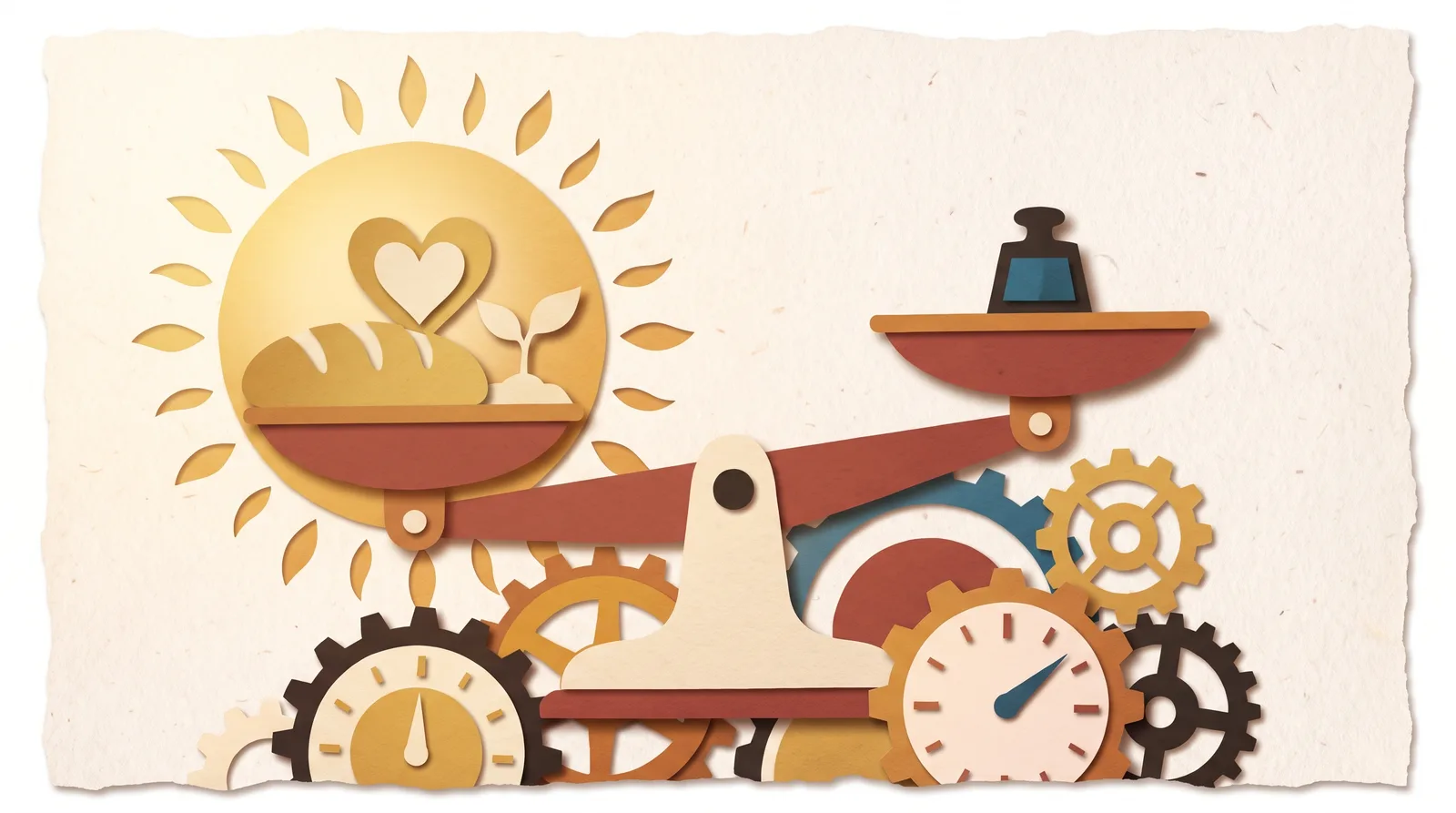
A picker of strawberries and a rescuer of lives shouldn't be rewarded the same. Once you decide that reward should follow benefit, you need a way to answer one question, over and over, for every act of work: how much benefit did this actually create? The payment algorithm is Copiosis's attempt at that answer.
It isn't a price set by haggling and it isn't a wage set by a boss. It's a measurement of results that produces a number — the size of the reward. Nobody negotiates it, nobody grants it as a favor, and the same act measured the same way produces the same answer for anyone.
The coreGood, minus harm
At its heart the calculation is simple to state. Take everything good an action produces for people and the planet. Subtract everything harmful. What's left is Net Benefit. If it's positive, the reward is positive and scaled to it. If the harm outweighs the good, there is no reward — and no punishment either; the work simply isn't rewarded, and the person is free to try something else tomorrow.
That one move quietly flips the incentive of an entire economy. Under money, harm is usually someone else's problem — a cost pushed onto a neighbor, a river, or the future, while the profit stays with you. Here, harm is subtracted from your own reward. The surest path to prosperity becomes leaving the world better than you found it.
Worked exampleWatch one contribution get scored
Imagine someone designs and installs a low-cost water filter that gives a small town clean drinking water for a decade. Here's the shape of how the algorithm would weigh it. The tally below is illustrative — the point is the method, not the exact figures.
Change the facts and the number moves with them. If the filter leached a toxin, the harm side would swell and the reward would shrink — perhaps to nothing. If ten thousand towns adopted the design, the benefit side would grow enormously. The reward isn't a fixed price tag on "a water filter"; it tracks the actual good this actual act put into the world.
The inputsThe scales it measures on
Copiosis describes the measurement as running across a set of scales — roughly eight — a standard list of questions asked about every contribution. They fall into two very different families of evidence:
Things you can count
How much was produced; resources and energy consumed; pollution created or avoided; health and safety outcomes; effects on the surrounding environment. Hard data, gathered from the world.
Things only people can report
How much the people served actually valued what they received — collected from the consumers themselves, rather than guessed at by a seller or a central planner.
Splitting the evidence this way is deliberate. Pure numbers miss what people care about; pure opinion drifts free of reality. Requiring both keeps the measurement anchored to what happened and honest about who it happened for.
Where values liveWeights: values, made explicit
Every factor carries an adjustable weight — and this is the point where human values enter the math on purpose, out in the open. A community can decide that environmental care, or children's wellbeing, or safety should count for more, and encode that choice where everyone can see it.
Money already does this — it just hides it. A price silently weights whatever a buyer will pay for and ignores whatever no one is billed for, which is why clean air and a stable climate tend to register as worth nothing until they're gone. Copiosis makes the same kind of choice a visible dial instead of a hidden default. You may disagree with where a community sets its dials, but you can see them, argue about them, and change them.
The shapeContinuous, and measured at every scale
The calculation isn't a one-time verdict. It runs continuously, updating as new information arrives — a benefit that keeps giving keeps being recognized, and harm that shows up later still counts. And it runs at every scale of society at once: the individual, the team, the neighborhood, the city, the region, the world. The same act can look different depending on how wide you draw the circle, so the algorithm doesn't pick one circle — it looks through all of them.
Reward flows to everyone in the chain who helped a benefit happen, each sized to their part — the designer, the maker, the person who taught the maker, the one who kept the lights on. Good rarely has a single author, and the measurement is built to notice that.
What it is notFour things the algorithm deliberately isn't
- It is not a price. Nobody sets it by what the market will bear; it's read off results, so it can't be inflated by scarcity or hype.
- It is not a wage. No employer owes it and no one can withhold it as leverage — it arrives after the fact, like recognition, not before, like a contract.
- It is not a punishment engine. Net-negative work earns no reward, but it triggers no fine, no debt, and no black mark. The only consequence is the absence of a reward.
- It is not a secret. The formula, the scales, and the weights are meant to be public and inspectable — the opposite of a price whose real drivers you never see.
 A fair worry
"Couldn't people just game it?"
Any system that hands out rewards invites someone to chase the reward instead of the point. It's the right question to ask, and Copiosis doesn't pretend to have closed every loophole. But two design choices make gaming harder than it is under money.
First, the algorithm measures results, not claims. You can't invoice for benefit that didn't land; the subjective scale asks the people supposedly served whether they actually valued it, and the objective scales check against the world. Second, because harm is subtracted, the usual trick — capture the upside, offload the damage — stops working, since the damage lands back on your own number.
 Being honest
What is, and isn't, settled
Keep exploringRelated deep dives
NBR, in Depth
The reward this number produces — created from nothing, non-transferable, gone when spent.
Read this →The Planet Dividend
What happens to the environment once harm is subtracted from every reward.
Read this →The Hard Objections
Gaming, laziness, the dirty jobs — the toughest questions, taken seriously.
Read this →The reward it produces
The algorithm decides how much. What you actually receive is Net Benefit Reward — and it behaves nothing like money.
NBR, in depthBack to Deep Dive