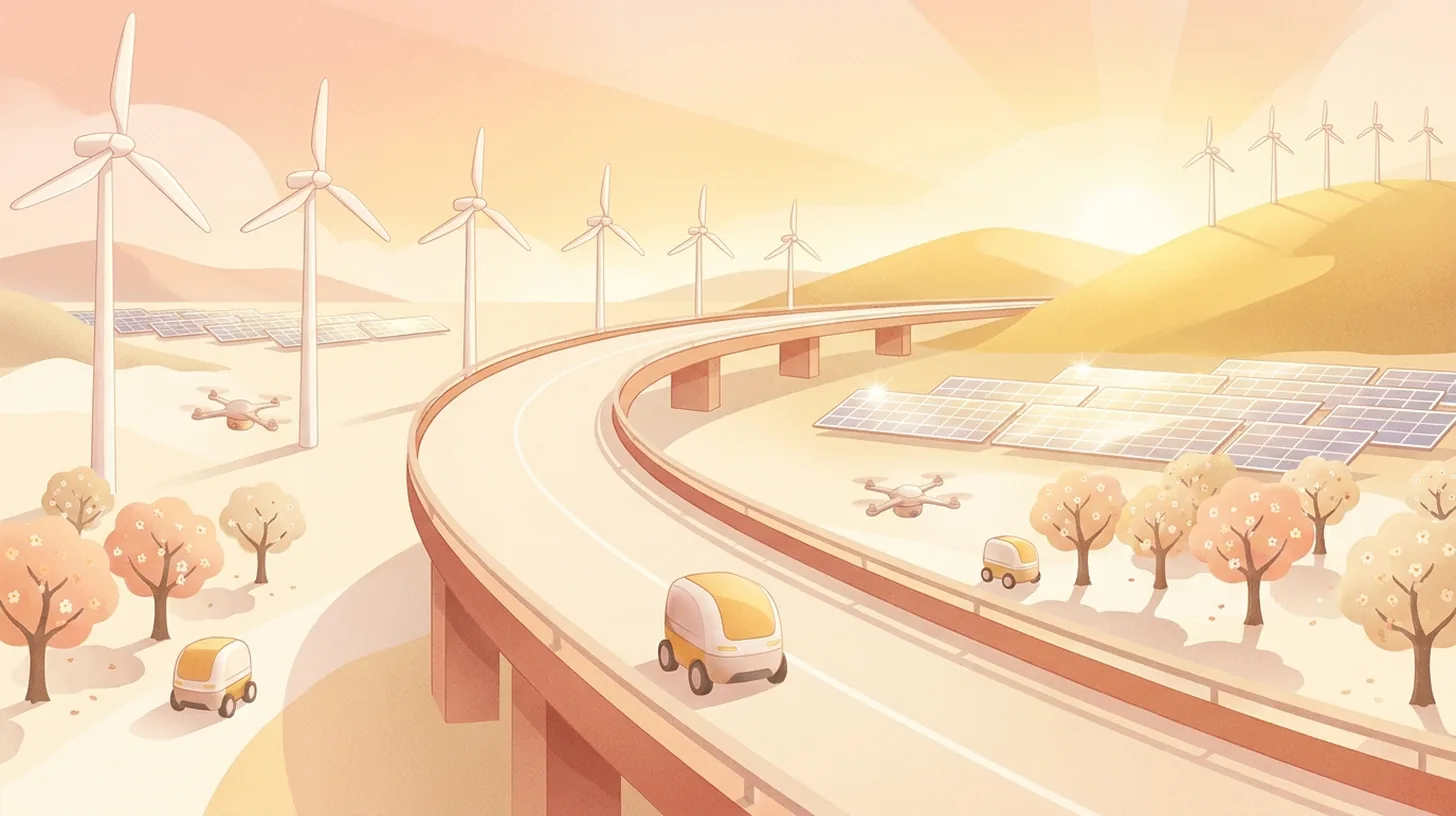
Every week brings another headline about what machines can do now — write code, drive trucks, read scans, fold laundry. Most coverage frames it as a threat. Here's the reframe worth sitting with: the same technology that menaces a money economy is quietly pouring the on-ramp to something better.
This is the first post in our Signals series — where we point at the abundance already leaking through into everyday life, and ask what it's telling us.
The quiet handoff
Step back from any single announcement and watch the trend line instead. Software now writes a meaningful share of new software. Warehouses hum with machines that don't clock out. Farms run on sensors, drones, and automated irrigation. Solar panels — machines with no moving parts — keep getting cheaper at a pace that has embarrassed every forecast made about them for decades. Cars are learning to drive themselves in ordinary traffic, in ordinary cities, right now.
Each of these is a handoff: a piece of the work of keeping humanity alive and comfortable, passed from human hands to machines that do it tirelessly, and increasingly, better. Handoffs like this are not new — we once put most of humanity to work growing food, and now a tiny fraction of us does it for everyone. What's new is the breadth. This wave isn't taking over one kind of work. It's reaching into nearly all of it at once.
And it's no longer just muscle work. The newest handoff reaches into work we always assumed was safely human: drafting documents, tutoring students, translating languages, reading medical images, designing parts, answering the phone. Whatever you make of any single tool, the direction is unmistakable — the share of valuable work that strictly requires a human keeps shrinking, year over year, across nearly every field at once. We are watching, in real time, the cost of producing what people need drift toward the cost of the energy and materials that go into it. That has never been true before. It changes what's reasonable to imagine.
We've been here before — almost
The classic reply writes itself: every past wave of automation destroyed old jobs and created new ones nobody saw coming. The plow drove people into factories, factories drove them into offices, and life got better. Maybe this wave repeats the pattern. But it's worth noticing what actually made those transitions work: each one left vast territories of work machines couldn't touch — and people migrated there. The farmhand's grandchildren became machinists, then accountants, then designers. There was always somewhere for human capability to go.
This wave is different in kind, not just degree, because it targets the general-purpose skills — perceiving, reasoning, communicating — that every previous refuge was built on. That's not a doomsday claim. It's a design question. If the refuges keep shrinking, the sensible response isn't to slow the machines down or to invent make-work so people can keep earning permission to eat. It's to ask whether survival should be routed through jobs at all.
Why this strains the old logic
Here's the uncomfortable part, and it's not the machines' fault. Our current economy runs on a loop: people earn wages by producing things, then use those wages to buy the things produced. Automation squeezes that loop from both ends. It makes goods cheaper and more plentiful — genuinely wonderful — while shrinking the paid work people rely on to afford them. The better the machines get, the harder it becomes to distribute their bounty through paychecks alone.
That's why so much automation coverage carries a tone of dread. Inside a money economy, abundance arrives looking like a layoff. The problem was never the productivity — it's that our distribution system only knows how to route prosperity through jobs. When a society openly debates shorter workweeks and tests basic incomes, that's not fringe thinking anymore. That's a system noticing, out loud, that its old assumption — survival flows through employment — is wearing thin.
Inside a money economy, abundance arrives looking like a layoff. That's a distribution problem, not a production problem — and distribution is exactly what Copiosis redesigns.
Designed for this moment
Now look at the same trend line through the Copiosis lens. In Copiosis, necessities are simply provided — food, housing, healthcare, education — with no bill attached. People earn Net Benefit Rewards for making life better for others and the planet, and those rewards buy life's luxuries. Notice what's missing from that design: nowhere does it require that humans do the routine labor. If a machine grows the food, the food still reaches people, because access was never chained to a wage in the first place.
That flips the meaning of every automation headline. A robot that takes over drudgery stops being a threat to someone's rent and becomes exactly what it should have been all along: a gift of freed human time. The engineer who automates a dangerous job, the team that makes clean energy cheaper, the person who uses their freed hours to care, create, teach, or discover — in Copiosis, the algorithm rewards all of it, because all of it makes life better. Machines produce the plenty; people are rewarded for directing it toward benefit.
And what do people do in a world where machines shoulder the routine? Every glimpse we get — retirements, sabbaticals, basic-income pilots — suggests the answer is not "nothing." People raise children and care for aging parents. They fix things, grow things, teach, coach, volunteer, study, make music, start projects that would never survive a business plan. Our current economy files most of that under "economically inactive," because no money changes hands. Copiosis calls it what it is — benefit — and rewards it accordingly. The freed hours aren't a problem to be managed. They're the payoff.
This is why we say AI is building the on-ramp. A world where machines shoulder most routine production is the world Copiosis was designed for. The technology is arriving on its own momentum, pushed by forces far bigger than any movement — and every advance makes the old excuse, "a world like that isn't practical," a little harder to say with a straight face.
What we'll be watching
This series exists to track the signals as they come in. A few we'll keep a running eye on:
- The cost curves. Solar, batteries, compute, robotics. Every time one of these halves in price, the material base for freely provided necessities gets a little more real.
- The labor share. How much of each industry's output still requires human hours — and where the freed hours actually go.
- The policy tells. Shorter workweeks, basic-income experiments, portable benefits — each one is a society quietly admitting that the job-centered bargain needs renegotiating.
- The mood. Notice how quickly "prosperity shouldn't depend on a paycheck" is turning from a fringe sentence into a dinner-table one. That shift in what's sayable is the most important signal of all.
An honest signal, honestly read
Automation is a precondition, not a proof. A paved on-ramp is not the same as a destination, and getting from one to the other takes design work, hard questions, and people — which is precisely the work this project exists to do.
But preconditions matter enormously. Ideas fail when they arrive before their moment; the ones that change everything are usually the ones waiting, fully formed, when the moment shows up. The abundance machinery is being built and paid for right now, by the very economy it will eventually outgrow. The question that's left is the one machines can't answer: how should the plenty flow? Through money, with all the distortions we've cataloged for centuries — or through something built to route it toward what actually benefits people and the planet?
We think that question is about to become the defining one. And when it does, there should be a well-worked-out answer on the table. If you want to see how the pieces fit — what happens to jobs, to ownership, to the incentive to excel — start with The Transition, or go deep on the hard objections. Skepticism welcome. That's what the road is for.