There is a kind of work every economy depends on absolutely and no economy records at all. If you have ever done it, you already know the strange doubled feeling of being indispensable and invisible at the same time.
Tuesday, as it happens now
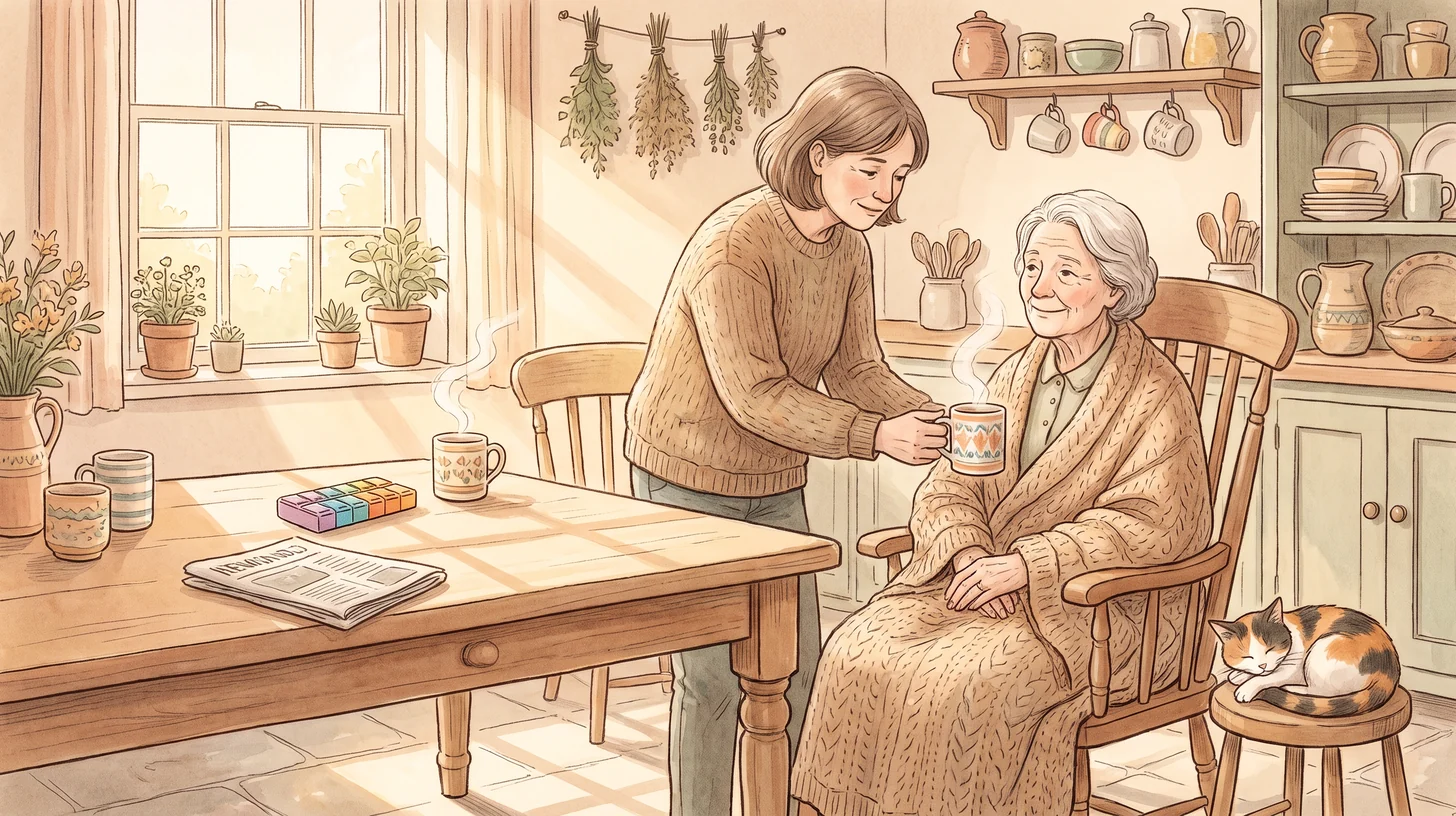
Ana is up at 5:40, before her mother, because the day goes better if the tea is already made. Medication at six, sorted the night before into a plastic tray with the days printed on it. Breakfast, slowly. The shower takes forty minutes and two of them, and it is the part of the day that costs her mother the most dignity, so Ana has learned to talk about something else the whole time.
Mid-morning is good. They do the crossword badly. There's a walk to the corner and back if the weather cooperates. The pharmacy calls about a substitution and Ana spends nineteen minutes on hold to find out whether it matters. Lunch. The afternoon is the hard part — around three her mother becomes certain that she has to get to work, that she is late, that Ana is a stranger keeping her from it, and the only thing that helps is patience Ana does not always have left.
Laundry. Dinner. The evening medication. Two wakings in the night, one of them long.
Ana left her job three years ago. The savings are most of the way gone. Nothing is accruing toward her own retirement. At a party, when someone asks what she does, she hears herself say: I'm not working right now.
What the ledger says her work is worth
Zero. Not "a little." Zero.
If Ana's mother were in residential care, that bed would cost a great deal of money every single day, and every unit of it would count as economic activity. Ana is providing something comparable, arguably better, and because no money changes hands, national accounts register nothing at all. There's an old joke among economists that if you marry your housekeeper, GDP falls. It's funny for about four seconds.
She isn't unusual. The International Labour Organization puts unpaid care work at roughly 16.4 billion hours a day worldwide — the equivalent of two billion people working full time for nothing — and estimates its value at something like 9% of global GDP. Women do rather more than three quarters of it. This is not a rounding error in the economy. It is a load-bearing wall the accounting simply declines to draw.
The most valuable thing she does all day is the one thing no ledger records.
The same Tuesday, in Copiosis
The 5:40 alarm doesn't change. The shower still takes forty minutes. Three in the afternoon is still the hard part. Anyone promising you otherwise is selling something.
What changes is everything underneath it. The house isn't billed. The food isn't billed. Power, water, the medication, the incontinence supplies, the grab rail in the bathroom that took four months to afford — none of it is billed, because necessities aren't. The savings account is not draining. There is no arithmetic running quietly in the back of Ana's head about how many more months of this they can manage.
And the work registers. Keeping a person safe, fed, clean, medicated and known is net benefit of an obvious and high order, so it generates NBR the same way any other beneficial work does. Not a wage. Not charity. Not a carer's allowance, grudgingly means-tested and set below subsistence on the theory that love should be its own reward. The same mechanism that rewards everyone else, applied to her, because what she is doing is plainly valuable.
What she does with it is her business. Possibly the good chair. Possibly a weekend where someone qualified takes over and she goes somewhere with a view. Possibly nothing, banked for later. The point isn't the chair. The point is that the answer to what do you do? stops being an apology.
Why the system would notice
Because the question it asks is different. Money asks: did a transaction occur? Care work fails that test for exactly one reason, which is that no one billed anyone. The Copiosis algorithm asks what good was produced and what harm was done, and care work passes that test easily — it just never gets asked.
The harm side matters here too. A society that quietly grinds its caregivers down is producing real costs: Ana's own health, her isolation, her lost decade of earnings, the crisis that arrives when she breaks before her mother does. Under money, all of that is externalized onto her, invisibly. Under a system that subtracts harm from reward, it's part of the calculation.
The part that stays hard
Copiosis doesn't cure the disease. It doesn't make three in the afternoon easier, doesn't give back the person Ana's mother used to be, doesn't take a single night waking off the count. Removing money from the picture removes exactly one layer of the weight.
It happens to be the layer most caregivers name first when you ask them what they'd put down if they could.
What we're not telling you
Measuring care benefit is genuinely difficult. It's easy to write that the algorithm counts it. It is much harder to specify how — what a good day is worth against a bad one, how you distinguish attentive care from adequate care without installing surveillance in someone's kitchen, how you avoid rewarding the appearance of care over the substance. That's open design work, not settled mechanism.
There's also a risk worth naming plainly: rewarding care work could entrench who does it. Women already carry more than three quarters of this labor. Attaching a reward to a role does not automatically redistribute the role, and a system that finally pays for care while quietly assuming the same people will keep providing it has fixed the ledger and left the injustice standing.
And some care shouldn't be done by an exhausted relative at all. It needs trained staff, equipment, and institutions. Copiosis makes that care free to receive, which is a real change, but it does not conjure the people who provide it.