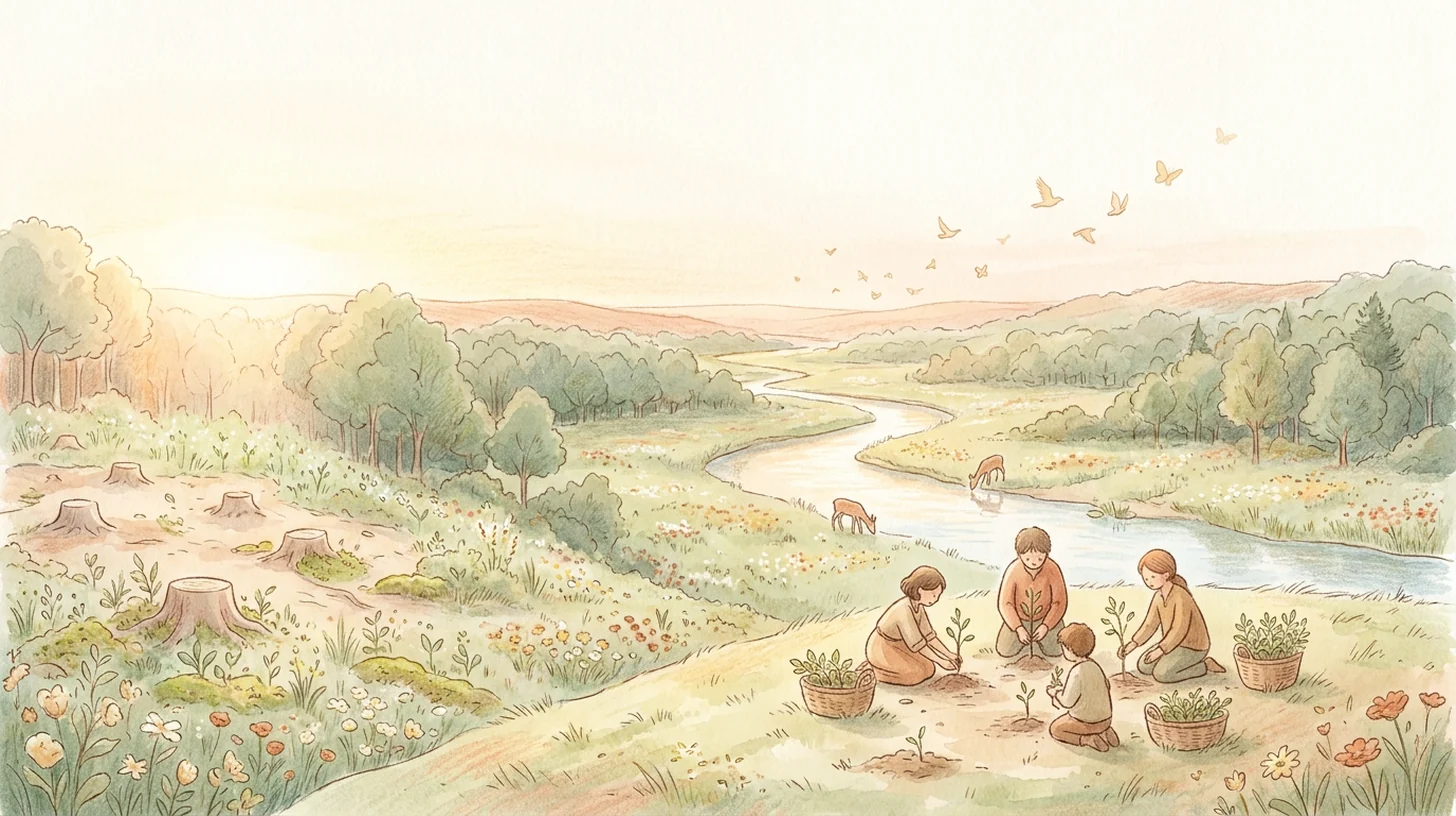
A question has been circulating in sustainability circles lately, and it's a good one: can a society protect biodiversity if its production models keep transforming ecosystems faster than those ecosystems can regenerate? The honest answer is no — and the question rather gives it away. What's actually worth arguing about is the next part: why does every production model we've built do this? Is that a fact about people, or a fact about the accounting?
We think it's the accounting. Which is the more hopeful answer, because accounting is something you can change.
Why it isn't the tragedy of the commons
The reflex here is Garrett Hardin's 1968 essay. A shared pasture with no owner; each herder gains the full value of one more animal while the cost of overgrazing is spread across everyone; the pasture dies of decisions that were individually rational the whole way down. It's a tidy story, and it has shaped fifty years of environmental policy toward two conclusions: give the commons an owner, or give it a policeman.
There are two problems with reaching for it here. The smaller one is that Hardin was describing open access, not a commons. Elinor Ostrom won a Nobel Prize for documenting the real thing — irrigation networks, inshore fisheries, alpine pastures — governed for centuries by the people using them, with rules, monitoring, and graduated sanctions, and no tragedy anywhere in sight.
The larger problem is that it doesn't describe what's happening to biodiversity now. The great majority of ecosystem conversion isn't unowned land being nibbled at by strangers. It is owned land, held under clear title, being converted legally and profitably by the people who own it — for soy, palm, cattle, timber, minerals. Enclosure didn't prevent that. Enclosure is what made it financeable. If ownership were the cure, the cure has been administered at enormous scale, and the patient is still declining.
The forest doesn't fall because nobody owns it. It falls because someone does — and the ledger says clearing it is the best available move.
Destruction is revenue. Repair is a cost.
Here is the asymmetry that actually sets the rate. Clearing an old forest converts a living system into a cash flow: timber sold, land improved, crop planted. Every step books as income and counts as growth. Restoring that same forest generates no revenue at all. It is an expense — funded by grants, donations, and the occasional budget line that survives until the next budget.
So the economy pays people reliably and generously to move ecosystems in one direction, and asks them to fund the other direction out of goodwill. And then we are surprised that the rate outruns regeneration. Of course it does. The whole slope tilts one way.
The standard fixes try to bolt a correction onto that tilt: fines, carbon prices, offsets, protected areas, impact assessments. They help, sometimes a great deal. But they fight the incentive from outside rather than changing it, they arrive after the damage has acquired a lobbyist, and not one of them ever makes repair pay. We've written before about why bolting it on keeps losing.
What changes when harm is subtracted
Copiosis makes one structural move: reward is calculated as benefit minus harm, before anyone is paid. Four things follow from that, and they land almost exactly on the question.
- Harm isn't fined. It's subtracted. There's no window in which you bank the proceeds of conversion and settle the damage later, if the case is ever brought. Wrecking an ecosystem doesn't yield a slightly smaller reward; past a point it yields none. You cannot get rich that way — while getting rich remains entirely available by every other route.
- Restoration becomes one of the best-rewarded things a person can do. Benefit to the planet is one of three explicit factors in the reward algorithm. Replanting a forest, reflooding a wetland, taking a dam out of a river — these create precisely the kind of benefit the measure exists to see. This is the part no regulation can deliver. Rules can slow the losing. Only this makes the winning pay.
- Regeneration rate can be written straight into the weights. The question is specifically about rate, and the algorithm's factors carry adjustable weights that a community sets and revises in the open. Harvest within a system's capacity to recover: rewarded. Exceed it: the sign flips, and flips harder the further past the line you go. That's a dial, not a lawsuit.
- The pressure to produce for its own sake goes away. A great deal of conversion exists to make things nobody especially wanted, because in a debt-based money economy you have to keep selling to survive — growth isn't an ambition, it's a repayment schedule. Copiosis issues no debt, so nothing compels growth, and necessities are free, so nobody clears land to make rent.
Put those together and the fastest route to prosperity stops running through a bulldozer and starts running through a nursery.
Follow one hillside
Today. A company owns a forested slope. Milling the timber and planting oil palm produces two decades of revenue and a gain booked the day the deal closes. Leaving the forest standing produces nothing anyone can bank — the watershed it protects, the carbon it holds, the species it shelters, the flood it prevents in the valley below are all entirely real, and none of them appear on a statement. The decision gets made by people who are not villains, using arithmetic that is not wrong.
In Copiosis. Same slope. Clearing it registers as serious harm to a living system, and that harm subtracts before anything is paid. Tending it — selective harvest inside the regeneration rate, watershed intact — registers as steady benefit and rewards steadily, year after year. And restoring the slope next door that somebody cleared in 2019 registers as high benefit and rewards well. Same hillside, same people, same self-interest.
Nobody in that second story became a better person. The arithmetic changed, and the behavior followed it.
What we're not telling you
Two honest limits, because this series doesn't work if we skip them.
The measurement is hard. All of it rides on ecological accounting, and some harm is delayed, some is diffuse, some is genuinely contested among scientists who are all arguing in good faith. Weight it too low and damage creeps back in; too high and useful work stalls. Copiosis doesn't claim this is easy. The claim is narrower and, we'd argue, more important: the measurement becomes the public, open, continually argued-over center of the economy, rather than a footnote nobody computes. Today ecological damage isn't measured badly. Mostly it isn't measured at all.
Netting has a blind spot at the edges. A species that goes extinct doesn't net against anything — there is no quantity of benefit elsewhere that brings it back. Thresholds, tipping points, and irreversibility need to be handled as hard limits rather than as very large negative numbers, and that is design work still ahead, not a solved problem. The citizen-jury process is where questions like that are meant to be settled, which is an answer about who decides rather than about what they should decide.
So: can a society protect biodiversity while transforming ecosystems faster than they regenerate? No. It never could, and no clever mechanism changes that. But the rate isn't a law of nature and it isn't a verdict on human character. It's the reading on an instrument we built and pointed in a particular direction. Change what the instrument rewards, and the rate follows — not because anyone was told to care, but because caring finally pays better than the alternative.