Why prices would fall, not rise.
The honest worry: if NBR can be created without limit, won't the luxuries it unlocks just keep getting harder to reach? It's a real question — one worth walking all the way through, because the usual engine of inflation turns out to be missing a part.
 The worry
The fear, stated fairly
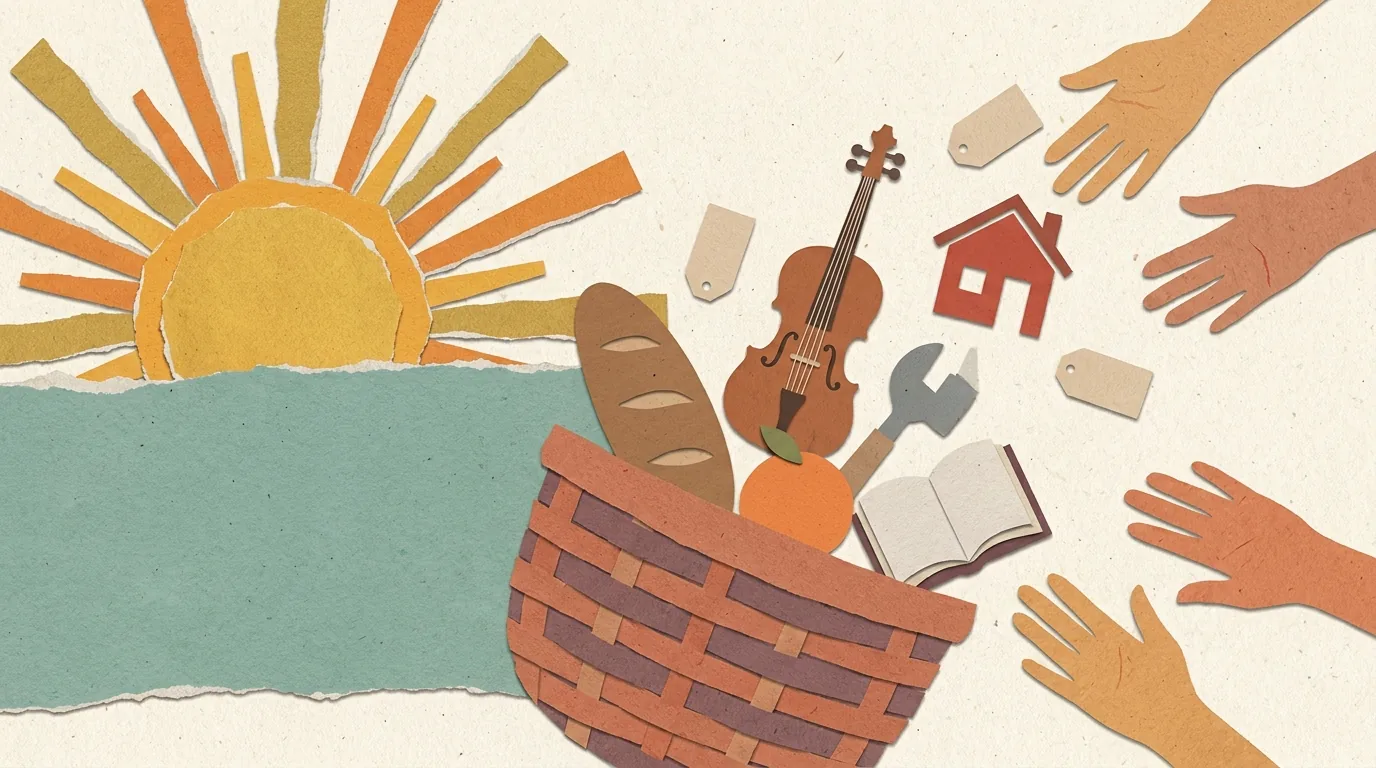
NBR is created from nothing, so its supply can grow without any ceiling. The luxuries you spend it on — a fine cello, a rare trip, a hand-built table — are not unlimited. Line those two facts up and you get the classic fear: more and more reward chasing a roughly fixed pool of nice things, so the NBR "gateway" on each one drifts upward, or the things simply run short and have to be rationed some other way. A luxury's gateway — the amount of NBR that unlocks it — isn't a price in the ordinary sense, since no seller is paid; but it can drift the way a price does, which is exactly the worry.
That's the exact shape of monetary inflation, and it deserves a real answer rather than a wave of the hand. So this page does two things in order: it looks honestly at how inflation actually happens, admits plainly where Copiosis is exposed to it — and then shows the part of the machine that pushes the other way.
 First principles
What actually moves prices
Before asking what happens in Copiosis, it helps to be clear about what makes prices rise or fall anywhere. Three forces do most of the work:
Supply and demand
When demand for something outruns its supply, its price tends to rise; when supply outruns demand, price tends to fall. Most price movement is just this, playing out good by good.
The size of the money supply
Independently of any single good, the total amount of money matters. All else equal, more money in the system pushes prices up across the board — which is precisely why governments tax rather than simply print what they need. Printing would dilute everyone's purchasing power.
Productivity — the escape valve
Here's the part that matters most. If real output grows as fast as the money supply, prices needn't rise at all: the new money is matched by new goods to spend it on. Inflation, at bottom, is money outrunning the stuff it can buy.
 Being straight
NBR isn't money — but it still unlocks scarce things
NBR breaks a lot of money's rules: it isn't traded, isn't lent, isn't a two-way medium of exchange. But honesty requires admitting what it keeps — you still need it to obtain luxuries, and luxuries are genuinely finite. So the worry can't be dismissed on a technicality.
If a rising tide of NBR meets a fixed set of luxuries, two things could happen, and both are real: producers could raise the gateway on their luxuries to match demand — inflation's close cousin — or the luxuries could simply run short and get handed out some other way, like a lottery among everyone who wants one. We're not going to pretend that pressure doesn't exist. The question is whether anything in the system pushes back on it.
 The counterweight
NBR is minted only in proportion to benefit
Recall the escape valve: money can grow without inflation as long as real output grows with it. In a money economy, that coupling is a hope — productivity might keep pace with the printing press, or might not. Copiosis builds the coupling directly into how reward comes into being.
NBR isn't printed by decree. A unit of it exists only because a specific, measured Net Benefit was produced and received. So the act that expands the "money supply" is the very same act that expands the real value behind it. The thing that normally causes inflation — new money arriving without new value to back it — is structurally restrained here, because you cannot create NBR without creating benefit first.
Push it one step further. In a money system the most valuable output is measured in goods; in Copiosis the headline output is Net Benefit itself — well-being delivered to people and the planet. That is the "productivity" the reward tracks. So when more NBR appears, it is (in the ideal) because more genuine benefit was produced — and rising real benefit is exactly the downward-pressure counterweight to the upward pressure of new NBR. The two are designed to cancel. (How the size of each reward is actually computed is the payment algorithm.)
 Second force
And the incentive leans toward reach
There's a second, independent reason the pressure runs down rather than up. Under money, a producer's goal is the most money per unit — which rewards charging high and, at the margin, holding supply back. Under Copiosis, reward only appears when your work is actually used, so the move that pays is the widest possible adoption: lower what you ask, improve the thing, make it easier to get. A cello nobody plays earns nothing.
Taken to its natural end, this pulls producers toward the necessity side of the line — where a good is free and reaches everyone — rather than guarding it as a scarce luxury to charge NBR for. (How that line between necessities, luxuries, and shared capital works is its own topic.)
A governorThe algorithm already watches scarcity
The reward isn't computed blind to supply and demand. Among its inputs, the payment algorithm weighs how scarce the resources behind a good are against how much they're in demand — so the amount of NBR generated is responsive to real conditions, not fixed regardless of them. It's not the only variable, but it means the system has a built-in sensor for exactly the scarcity that would otherwise drive a gateway upward.
 The switch-over
The transition worry
There's a sharper version of the fear that shows up at the moment of transition. To make sure no one is worse off crossing over, existing debts and assets — cash, stocks — get converted into NBR. Fair enough. But then a pointed question follows: if a lot of new NBR is minted afterward, do those early holders quietly lose purchasing power — a kind of stealth "tax" on the people who were wealthy before Copiosis?
Two things soften it. First, the counterweight above: post-transition NBR tracks new benefit produced, so it isn't pure dilution of a fixed pie. Second, the pool of people earning NBR isn't ballooning — world population is expected to level off, so no flood of new claimants erodes anyone's relative standing, and those holding more productive property keep generating NBR from it. Still, the honest takeaway is that managing the minting rate after the switch is a real responsibility, not something the design gets for free.
 Why the stakes differ
Even if some gateways drift, it bites far less
Here's the part that reframes the whole worry. Money ties your survival to your purchasing power — so monetary inflation genuinely hurts, because it can price you out of food, shelter, and care. Copiosis severs that link. Necessities are free no matter what NBR does, so any "NBR inflation" can only ever touch luxuries — never your security. The floor under your life doesn't move.
And there's a deeper decoupling. Money quietly assumes that more purchasing power means a better life; Copiosis doesn't. It measures Net Benefit — actual well-being delivered — rather than treating "more stuff" as the goal. Research has long suggested wealth tracks happiness only loosely, and only up to a point. So even a drifting luxury gateway doesn't erode the thing the system is actually built to produce. NBR "inflation," if it happens, is a smaller kind of problem than the one it replaces.
Being honestWhere this stops short of a promise
The forces lean the right way, but this isn't a proof of stable gateways. The honest limits:
- Genuinely finite things — an original painting, a plot with a rare view — can still command a great deal of NBR. No incentive makes more of them.
- The counterweight is only as good as the measurement. If the algorithm over-mints relative to real benefit, the coupling loosens and pressure returns.
- Getting the post-transition minting rate right is a live design responsibility, not an automatic result.
 Keep exploring
Related deep dives
The Trouble With Money
Why the thing being replaced concentrates, coerces, and welds survival to purchasing power in the first place.
Read this →The Payment Algorithm
How each reward gets sized — good minus harm, with resource scarcity and demand among the inputs.
Read this →NBR, in Depth
The reward itself — created from nothing, non-transferable, and gone the moment it's spent.
Read this →So where does the reward itself come from?
The gateway is one half of the picture. The other half is how the reward gets sized in the first place — an open algorithm weighing benefit to people and planet against any harm.
NBR, in depthBack to Deep Dive