How order appears with no one in charge.
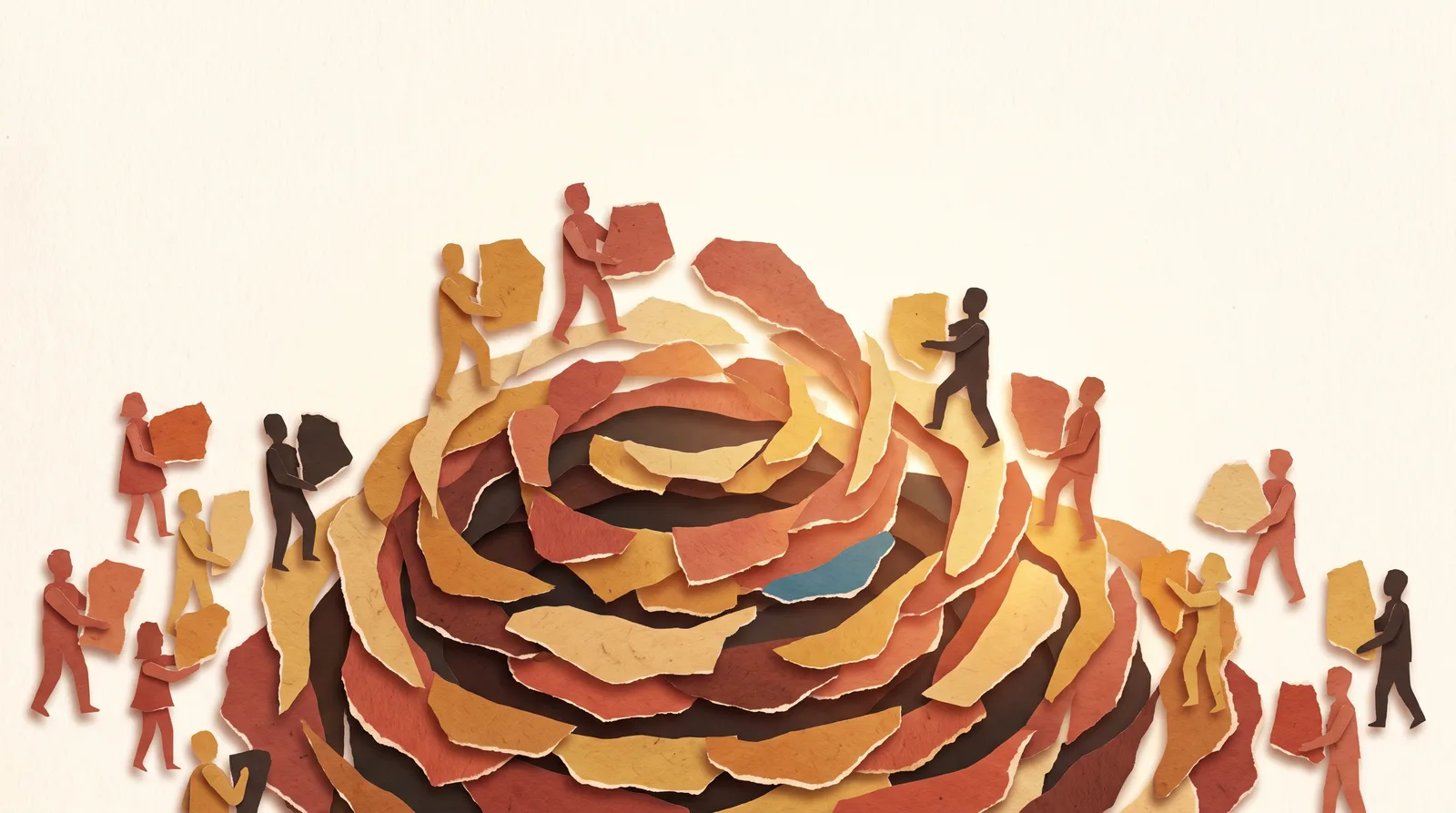
Stigmergy is the quiet mechanism under Copiosis's "no rulers" claim — coordination that emerges from people reading and leaving signals in a shared world, the way a colony builds without a foreman.
 The word
What stigmergy means
The term was coined in 1959 by biologist Pierre-Paul Grassé, studying how termites build elaborate mounds with no architect, no blueprint, and no one giving orders. His answer: each termite responds to the state of the work itself. A small deposit left by one triggers the next to build there; that larger structure triggers the next response, and so on. The building is the instruction. Coordination without communication, carried entirely by traces left in a shared environment.
Ants do the same with pheromone trails: a forager that finds food lays a scent on the way back; others follow it and reinforce it; when the food runs out the trail fades. No ant holds the plan. The plan lives in the environment, written and read one small action at a time.
 The mechanism
The loop that does the work
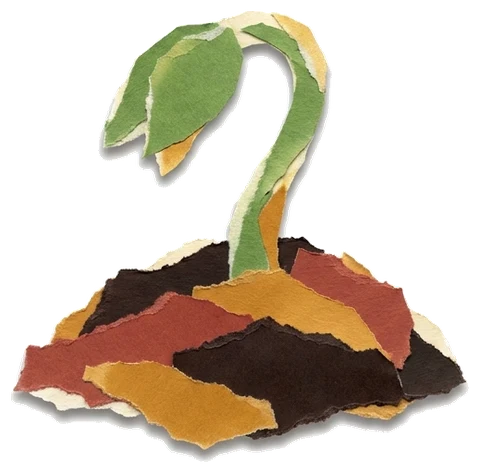
Strip stigmergy to its bones and it's a simple loop with two ingredients — a shared medium that holds signals, and agents who react to what's near them and leave something new behind.
Sense a local signal
An agent notices something in its immediate environment — a scent, an unmet need, a half-finished thing.
Act on it
It does the next useful thing in response — carries, builds, fixes, supplies.
Leave a new trace
That action changes the shared environment, becoming a signal others can read.
Everyone repeats
Thousands of these small loops, running in parallel, add up to coordinated structure no one designed.
 You've seen it already
Stigmergy is all around you
This isn't an exotic idea from an ant lab — humans coordinate this way constantly, usually without naming it.
Ant trails
Follow the scent, reinforce it, let it fade — a living map with no mapmaker.
Desire paths
The worn shortcut across the grass: each footstep makes the next walker likelier to follow.
Wikipedia
Each edit is a trace the next editor builds on. An encyclopedia writes itself, no editor-in-chief.
Market prices
A price is a signal everyone reads and reacts to — stigmergy money already relies on.
In CopiosisWhat the signals are here
Copiosis runs on stigmergy with a richer set of traces than price alone. Its shared medium is made of two visible things: needs that are unmet and rewards that follow benefit. An unmet need is a signal that pulls effort toward it; the reward that appears when someone meets it is a trail that tells others "there's real good to do here." People respond to what's near and visible to them — and the coordination is the sum of those responses, exactly as in the colony.
Coordinators are people who get especially good at reading and strengthening these signals — amplifying a need, connecting a supply — but even they command no one. And because the reward signal is benefit-minus-harm rather than price, the trails point at doing genuine good, not merely at what sells.
Three ways to organizePlanning, price, or benefit-signals
Every large system needs some way to coordinate strangers. There are broadly three answers, and they fail and succeed differently.
Why lean on itWhat self-organization buys
- It scales without hierarchy. Add more participants and you add more coordinating capacity, not more management layers.
- It's robust. No central brain means no single point of failure; the system routes around gaps.
- It's adaptive. Signals update in real time, so effort follows where it's actually needed now, not where a plan guessed months ago.
- It offers little to capture. With no central controls and no transferable wealth, there's no throne to seize — the reason Copiosis calls itself ruler-free.
 Being honest
Self-organizing isn't automatically good
Keep exploringRelated deep dives
Who Actually Runs It
The roles this mechanism runs through — coordinators, juries, and order without a boss.
Read this →The Payment Algorithm
The benefit-minus-harm signal that stigmergy follows here instead of price.
Read this →A Day in Copiosis
Watch the signals get read and left, and order appear with no one in charge.
Read this →So who tends the signals?
Self-organization still needs roles — coordinators, juries, an open volunteer body — without any of them becoming a ruler. Here's how that works.
Who actually runs itBack to Deep Dive