In our first Signals post we promised to keep a running eye on the cost curves — solar, batteries, compute, robotics. Here's why those four curves deserve a standing watch, what they've already done while nobody was framing it this way, and what they're quietly saying about the price of keeping everyone alive.
The most reliable trend nobody talks about
Headlines run on events. But the forces that actually reshape civilizations tend to be curves — slow, compounding, boring right up until they're unstoppable. The pattern is called a learning curve, and it's one of the most durable regularities ever measured in economics: for many manufactured technologies, every time cumulative production doubles, cost falls by a roughly constant percentage. Not because of any single breakthrough — because thousands of small improvements compound as humans make more of a thing.
The canonical example is solar power. A solar panel's watt of capacity cost hundreds of times more in the 1970s than it does today — a decline of well over 99%, sustained across five decades, through oil shocks, recessions, and every prediction of its flattening. Lithium batteries have followed their own version of the curve since the early 1990s, down around ninety-something percent and still falling. Computing has been riding cost collapses for seventy years; the cost of a unit of AI capability is now falling faster than almost any technology ever measured. These aren't projections. They're history — measured, public, and remarkably stubborn.
Abundance isn't arriving as an event. It's arriving as a slope — and the slope has held for fifty years.
Why these four curves, specifically
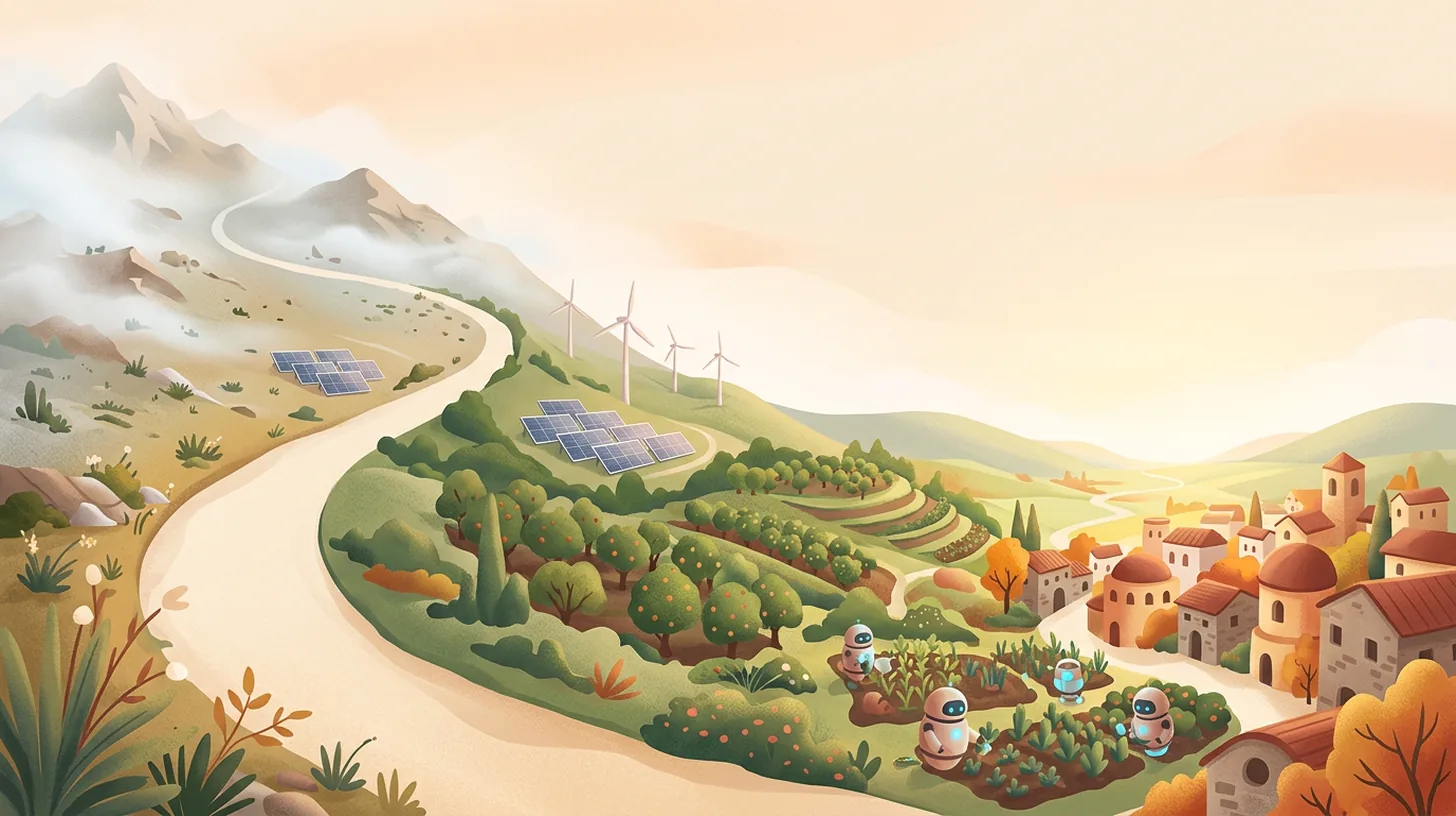
Because stacked together, they are the supply chain of survival. Trace any necessity to its roots and you find the same inputs: energy to grow, make, and move things; storage to have that energy when needed; intelligence to organize and optimize; and manipulation — machines that physically do the work. Those are the four curves, and every one of them is pointed down and to the right:
- Energy (solar). The cost of harvesting sunlight has fallen so far that in much of the world, building new solar is cheaper than merely operating old fossil plants. Energy is the master input — when it gets cheaper, everything made with it follows.
- Storage (batteries). Cheap energy you can hold means cheap energy always — the difference between solar as a supplement and solar as a foundation.
- Intelligence (compute and AI). The cost of a unit of thinking — diagnosing, translating, designing, coordinating — is in free fall. We wrote a whole post about what that hands off.
- Manipulation (robotics). The youngest curve, and the one to watch hardest: robots are batteries, sensors, and intelligence in a body, so their curve inherits the other three. When capable manipulation gets cheap, the last physical bottlenecks — harvesting, building, caring for the material world — start their own descent.
Notice what sits at the intersection: food is energy, water, land, and handling. Housing is materials, energy, and labor. Healthcare is knowledge, attention, and logistics. The cost curves aren't tech-industry trivia. They are, collectively, the falling price of the necessities themselves.
What this says in Copiosis terms
Copiosis makes a specific structural claim: a society can provide everyone's necessities without charging for them, and reward people through NBR for making it happen. The standing objection has always been arithmetic: surely keeping everyone alive costs too much. The curves are the arithmetic answering back. Every halving in the cost of energy, storage, intelligence, and manipulation shrinks the real-resource bill for universal necessities — not the dollar bill, the actual bill, the one paid in land, energy, materials, and human effort. The claim gets easier every year, and it gets easier whether or not anyone is trying to make it come true.
That last part is what makes this a signal rather than a hope. Nobody driving these curves is doing it for a moneyless world. They're chasing quarterly advantage — and in the process, building the material base for a system that will need very little convincing once the base exists. The old economy is financing its own successor's infrastructure. There's a certain poetry in that.
What the curves don't promise
Honesty section, as always. Learning curves apply to things we manufacture — they say nothing about land, and beachfront will never ride one. Some inputs are stubborn: certain minerals, certain skills, human attention and care — the hour a nurse spends holding a frightened patient's hand doesn't halve in cost, ever, and shouldn't. That's exactly why Copiosis isn't "everything is free": luxuries stay priced in NBR precisely because some scarcity is real and permanent. Curves also bend — supply chains kink, minerals bottleneck, politics interferes; the slope holds over decades, not every quarter. And cheap capability is not the same as a built system: panels don't install themselves, and abundance in a warehouse is not abundance in a home. The curves lower the cost of the destination. The road still has to be walked.
But watch them anyway. Watch them the way a farmer watches the sky. Every year the curves run, the honest answer to "can we actually afford a world where nobody's survival is billed?" shifts a little further from someday toward sooner than you think. That's the signal. It's been broadcasting for fifty years, and it's getting louder.