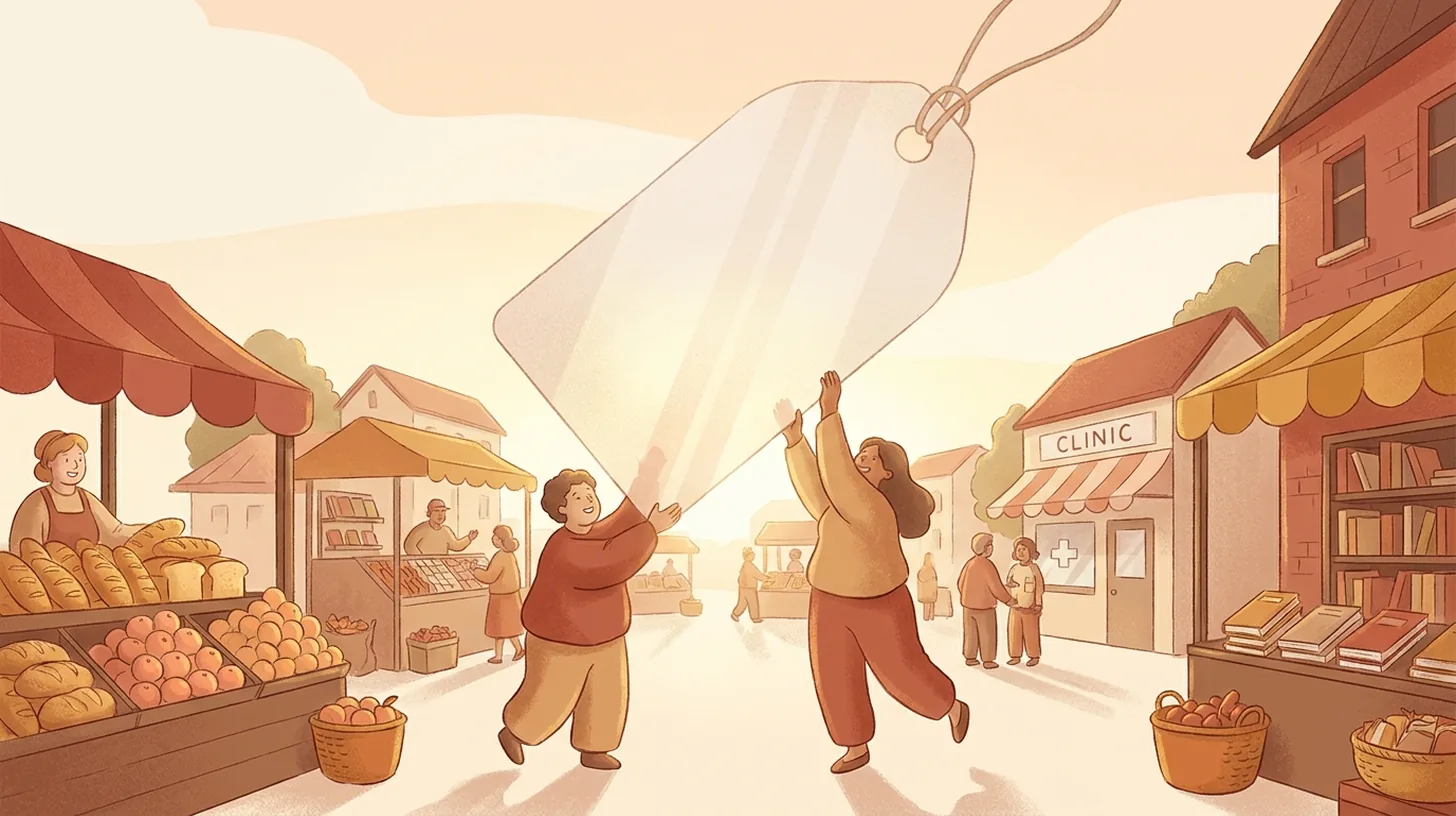
Explain Copiosis to anyone — free necessities, no money, rewards for benefit — and you can set your watch by the first response: "Sounds lovely. Who pays for it?" It's a fair question, honestly asked, and it deserves a straight answer instead of a subject change. So here's the straight answer. It comes in two parts, and the second part matters more than the first.
This is the first post in our Straight Answer series, where we take the hardest objections to Copiosis head-on — steelmanned, not strawmanned — and don't flinch. If you collect objections, we keep the full set here.
Part one: nobody — and that's not a dodge
In Copiosis, nobody pays for anything, because paying is not a thing that exists. No money, no prices on necessities, no bills, no taxes, no budgets. Saying "but who pays?" about Copiosis is like asking who tills the soil on a hydroponic farm — the question imports a mechanism from one system into another that simply doesn't use it.
Now, that answer alone should satisfy nobody. It sounds like a magic trick, and your suspicion of magic tricks is healthy. Hospitals don't materialize because we stopped charging for them. Something real has to make them exist. Which is exactly the point — so let's talk about what actually makes things exist.
What actually pays for everything, everywhere, always
Take any good you've ever "paid for" — a loaf of bread, an MRI, a bridge — and trace it all the way down. At the bottom you will always find the same short list: land, energy, materials, knowledge, machines, and human effort. That's it. That's what everything is made of. Money appears nowhere on the list, because money doesn't make anything. Money is the permission system we currently use to decide who may use those real things, and when, and how much of them.
This isn't a Copiosis claim; it's Economics 101 wearing its own clothes. Economists call the real list "factors of production" and money "a medium of exchange." The wheat, the ovens, the bakers, and the know-how are the economy. The dollars are the scoreboard we bolted onto it.
Money doesn't create hospitals. People, materials, energy, and knowledge create hospitals. Money is just our current system for granting permission to use them.
Once you see that, "who pays for it?" resolves into the question actually worth asking: if we swap out the permission system, will the real resources still show up? Will people still bake, build, heal, and haul? Will materials still flow to the people doing it? That is the right question — and it has a real answer, not a hand wave.
Part two: why the real resources still show up
Copiosis replaces the permission system with two mechanisms, and it's their combination that does the work.
First: producers are rewarded — personally, permanently, and in proportion to benefit. The baker whose bread feeds a neighborhood, the crew that maintains the water system, the nurse, the farmer, the engineer — each earns Net Benefit Rewards as the benefit of their work actually lands. And here's the detail most people miss: providing necessities is among the best-rewarded work in the system, precisely because keeping people alive and well is enormous measurable benefit. In our world, feeding people cheaply is a low-margin business. In Copiosis, feeding people well is a fortune in reward. The incentive to provide essentials doesn't survive the transition — it strengthens.
Second: producers don't need to buy their inputs. Flour, ovens, trucks, clinic equipment — capital goods flow to producers at no cost, provided they're put to beneficial use, with the whole chain visible and scored on net benefit. The farmer supplying the baker earns reward when the bread does good. Every link in the supply chain is paid in the same currency of benefit, so the chain holds together without a single invoice moving along it.
Put the two together and follow the loaf of bread: the wheat grows because farming is rewarded; the flour moves because supplying is rewarded; the baker bakes because baking is rewarded; you eat because eating is a necessity and necessities are free. At no point did anyone need to collect money from you — and at every point, someone was better off for having contributed. The "funding" of the system is the same as it ever was: people doing real things with real resources. Only the bookkeeping changed.
"So NBR is just money with extra steps"
A sharp reader objects: you've renamed money and called it a day. But look at what NBR doesn't do, because the differences are the whole design. NBR is created from nothing when benefit is measured — it isn't collected from anyone, so rewarding one person never requires taking from another. It's non-transferable — you can't give it, pay it, bribe with it, or inherit it, so it can't concentrate into leverage over other people. And spending it destroys it — it doesn't circulate, so there's no money supply to inflate, hoard, or crash. It's less like money and more like a reputation score you can trade in for luxuries. If the inflation worry is nagging at you anyway, we wrote a whole page on it.
The part nobody budgets for: what we'd stop paying
Here's the mirror question no one ever asks: who pays for money itself? Because moneyness is not free. Somebody staffs the billing departments, the claims processing, the collections agencies, the debt servicing, the invoice reconciliation, the fraud triage on all of the above. In some industries the machinery of charging for the product costs a substantial fraction of what the product itself costs — ask anyone who's seen healthcare administration from the inside. A vast share of human work-hours goes not into making things better but into deciding who may have them and extracting payment. Copiosis doesn't have to fund any of that, because none of it has anything left to do. The first thing a moneyless system buys is the retirement of the entire cost of money.
What the question gets right
Let's give the objection its due, because buried inside it is something true: real constraints don't vanish. There is only so much lithium, so many surgeons, so much beachfront. Copiosis doesn't pretend otherwise — that's exactly why it isn't "everything is free." Necessities are free; luxuries carry a price in NBR, set in part by how scarce and how costly to the planet they are. Scarcity still disciplines consumption — it just does its work through the luxury gateway instead of through hunger.
And yes, one big question remains genuinely hard: not "who pays?" but "how do we get there from here?" — what happens to dollars, debts, savings, and mortgages on the day the systems switch. That's a transition question, the design has an answer, and it's big enough that it gets next week's post all to itself.
So keep asking hard questions — just aim this one where it belongs. Not "who pays for it?" The real resources pay, same as they always have. The question is whether people will still be moved to contribute them. And a system that makes contributing the only path to a rich life has a better claim on that answer than one that pays its bakers as little as it can get away with.