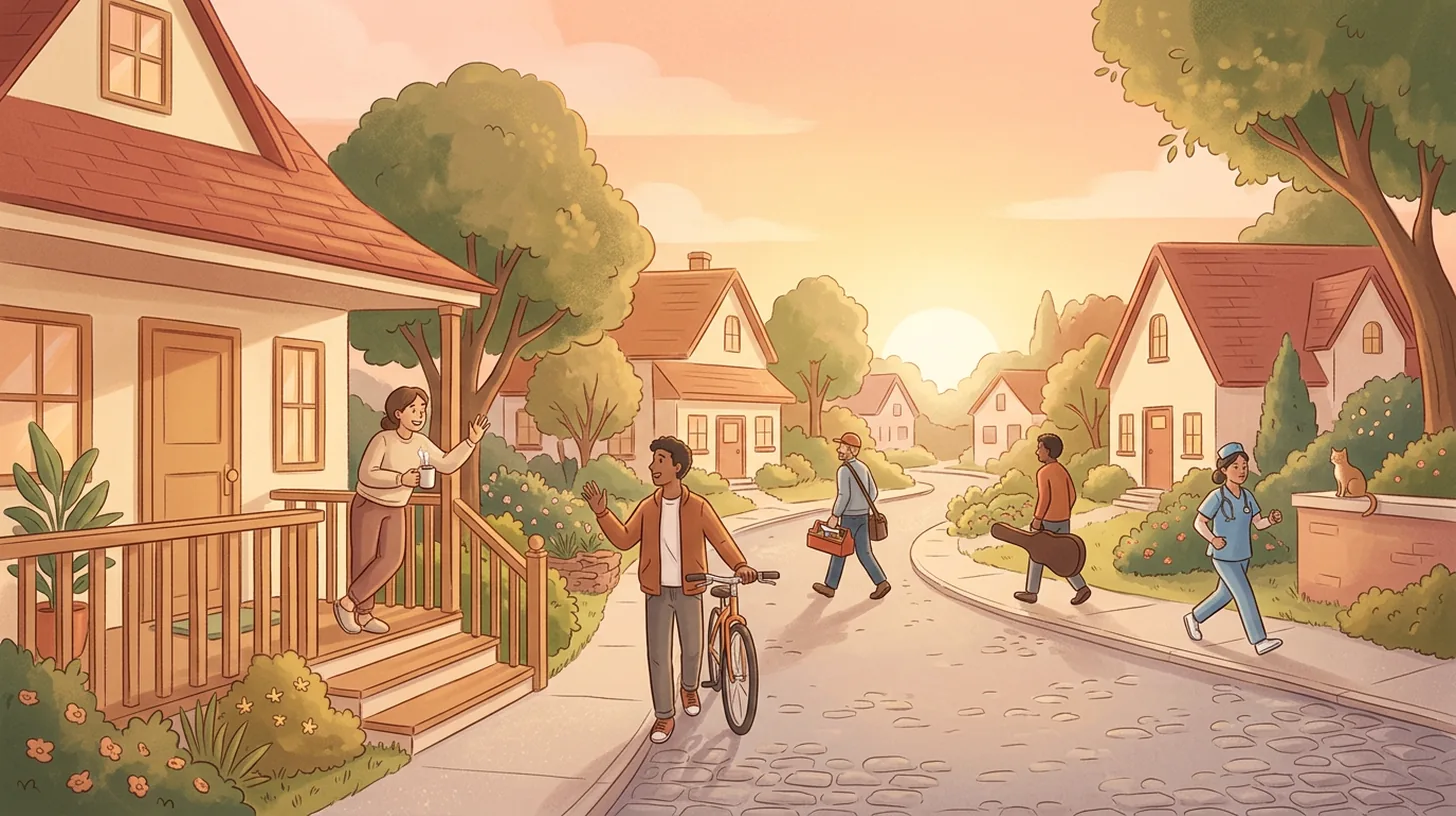
There's a feeling most of us know so well we've stopped noticing it: the Sunday-evening tightening, the alarm that lands like a summons, the arithmetic that runs under every Monday — I do this because the rent is due. Now try a thought experiment. Remove the arithmetic. What's left of Monday?
This is the first post in our A Day In… series — small, imagined walks through ordinary life in a Copiosis world. Imagined is the honest word: nobody lives this way yet. But this isn't idle daydreaming either. Every detail below follows from the actual design — necessities provided to everyone, and Net Benefit Rewards earned by making life better for people and planet.
6:40 a.m.
The alarm still goes off, because Dana still set it. That's the first thing worth noticing: mornings don't dissolve just because the paycheck did. Dana is a nurse, and the clinic opens at eight, and people will be there who are hurting. What's gone isn't the schedule. It's the undertone. Dana isn't going to the clinic today or else. The rent isn't due, because there is no rent — housing is a necessity, and necessities don't carry price tags. Dana is going because eleven years in, it turns out the work itself was always the point. Plenty of us suspect we'd feel that way about our own work. Some of us suspect the opposite — and that difference is exactly what this morning is about.
7:15 a.m.
Coffee on the porch. Across the street, Sam is loading a toolbox onto a cargo bike. Sam used to process insurance claims — forty hours a week deciding which sick people's paperwork was filled out correctly. In a world where necessities flow freely, that entire industry simply has nothing to do; nobody needs permission to see a doctor. So Sam does what Sam quietly wanted to do for twenty years: fix things. Broken stair rails, stuck windows, leaky valves, other people's hopeless bicycles. Every repair makes someone's life measurably better, and the algorithm notices measurable benefit. Sam earns more recognition now than the claims job ever paid — and sleeps better, too.
Here's the part the skeptic in you should chew on: in our world, Sam's repair work would be a hobby, squeezed into weekends, "economically inactive." In Copiosis it's simply production. The work didn't change. The accounting did.
Remove the threat from Monday and work doesn't stop. It sorts — away from what only existed to move money around, toward what actually helps somebody.
8:00 a.m.
At the clinic, Dana's morning looks almost unchanged from the old world — vitals, charts, the seven-year-old with the ear infection. Two things are different. First, the waiting room: nobody in it is calculating whether they can afford to be there, because care is a necessity, full stop. The people who used to wait until Friday's paycheck to see someone about the chest pain don't wait anymore. Second, the staffing: everyone in the building chose this. The colleague who was coasting toward a pension, openly counting the days? Gone — happily, without drama, doing something else. What remains is a smaller, sharper team of people who want to be exactly here. Ask any nurse what that would do to a workplace.
9:15 a.m.
Between patients, the part of the thought experiment most people demand first: the truck pulls up for the clinic's medical waste. Meet Marcus, who does a job nobody romanticizes — and here's the detail worth slowing down for: Marcus is, by the neighborhood's standards, conspicuously well rewarded. In our world, we've arranged things exactly backwards — the more essential and unpleasant the work, the less we tend to pay for it, because the people doing it usually have the least leverage. Copiosis has no leverage, only benefit — and hauling biohazards away from a building full of sick people is enormous, measurable benefit that few people volunteer for. Scarce willingness plus high benefit equals outsized reward. That's not charity toward Marcus; it's just the arithmetic pointed the right way up.
And there's a second half to the answer: every producer has a standing incentive to automate the miserable parts, because machines that do unpleasant work generate benefit too — for the people who no longer have to do it. Marcus, for what it's worth, is on the design team for the system meant to replace his own route. In our world that would make him a man engineering his own layoff. In this one, it's just his next contribution.
10:30 a.m.
Mid-morning, a visit from a coordinator — in Copiosis, the person whose job is matching work that needs doing with people inclined to do it. The clinic's ancient ventilation system needs replacing; a crew two towns over specializes in exactly that, and materials are capital goods, provided at no cost to producers who put them to beneficial use. No purchase orders, no budget meetings, no quarter-end freeze. The question is never "can we afford it?" — it's "is it worth doing?" Those turn out to be very different questions, and the second one is refreshingly hard to game.
12:40 p.m.
Lunch at home with her father, who has needed daily help since his stroke. In the old world this was Dana's invisible second shift — unpaid, uncounted, the thing she did after the job that "mattered." In Copiosis, caring for another human being is among the most direct benefit there is, and the algorithm treats it that way. The hour she spends helping him with exercises earns reward the same way her clinic shift does: someone's life, made measurably better. For the millions of people — overwhelmingly women, in our world — whose caring work has never appeared in any ledger, this single design choice may be the quietest revolution in the whole blueprint.
3:00 p.m.
An afternoon hour on the thing nobody assigned: Dana is slowly building a hypertension-screening program for the neighborhood, with a retired cardiologist and a teenager who's good with spreadsheets. In our world this would need a grant application, a fiscal sponsor, eighteen months of waiting. Here it needs an idea, willing hands, and results. If it works — if blood pressures actually drop — the benefit is real, the reward follows, and the idea spreads because good work leaves visible trails for others to build on. If it doesn't work, they'll learn why and try differently. The cost of attempting things that might help people has fallen to almost nothing. Sit with what that would unleash.
4:45 p.m.
Walking home, Dana passes Theo's place. Curtains drawn, telltale glow. Theo doesn't work — not clinic-work, not toolbox-work, not spreadsheet-work. Theo games, mostly, and has for the better part of a year. Let's not flinch from it, because every honest description of a world with free necessities has to include Theo. He's fed. He's housed. He sees a doctor when he needs one. None of that is conditional, because in Copiosis nothing about staying alive is conditional — that's the point of the whole design, and it doesn't come with an asterisk for people we disapprove of.
What Theo doesn't have is everything else. The luxuries that make life rich flow through NBR, and NBR flows only from benefiting others — so Theo's world is secure but small, and stays small until he wants otherwise. Nobody's starving him out; nothing is coercing him back. But notice what our world's version of Theo looks like: trapped in a job he does badly and resentfully, or churning through unemployment systems engineered to humiliate him. Copiosis just lets Theo be at rest until something pulls him — and things do pull people. Sam spent two decades wanting to fix things. The door out of a small life is always open, and walking through it is rewarded from the very first step.
6:30 p.m.
Evening. Dinner ingredients from the market — no checkout, necessities are simply stocked and taken as needed, restocked by producers who earn NBR for doing it well. Dana checks her NBR balance the way you might check a garden: the clinic shift, the hour with her father, a small steady trickle from the screening program as its early numbers come in. That balance buys the things that make life delicious rather than merely secure — the luxuries: the good guitar, the trip, the beautiful coat. The ambition to have wonderful things hasn't gone anywhere. It's just been rewired to run through benefit instead of leverage.
What didn't change
It's worth ending the day with an inventory of everything this Monday kept, because utopias lose people the moment everything sounds soft. The alarm still rang. The shift still ran long. The seven-year-old still screamed about the ear drops, the ventilation project will still hit snags, and somewhere in the clinic two colleagues still quietly can't stand each other. Deadlines exist, because patients and seasons and curing concrete don't care about anyone's economic system. Excellence is still rare and still admired. Ambition still burns in the people it burns in — Dana wants her screening program to win, wants it noticed, wants the beautiful coat. Difficulty, friction, striving, even status: all still here.
What's missing is exactly one thing: the fear underneath. The or else. And the strange discovery of this thought experiment is how much of what we call "the economy" turns out to be scaffolding for that fear — the claims-processing, the collections calls, the make-work, the staying-late-to-be-seen — and how much room opens up when it goes.
The honest coda
No one is living this Monday yet. Copiosis is a design — a worked-out, inspectable design — not a place you can visit. And a fair reader will have objections queued up: who does the miserable jobs? What about the lazy? Who decides what counts as benefit? Good. Those questions have serious answers, and we've collected the hardest ones — steelmanned, not strawmanned — on the objections page.
But notice what the walk-through reveals. Nothing in Dana's Monday required anyone to become a better person. Same alarm, same skills, same love of the work, same wish for nice things, same imperfect neighbors. All that changed was the plumbing underneath — what flows to whom, and why. That's the quiet claim at the heart of Copiosis: we don't need new humans. We need a better Monday for the ones we have.